1 min read
Microsoft Entra Suite: Simplified Zero Trust Security
What Is the Entra Suite? Microsoft’s Entra Suite is for organizations seeking robust security solutions. Released recently, it brings together a...
12 min read

The energy sector faces over 1,100 weekly cyberattacks per utility, with 67% of breaches linked to third-party software and IT vendors.
This figure reflects the growing complexity and risk facing energy companies as they modernize operations and connect more systems than ever before.
The challenge is no longer about building higher walls around the network. Instead, it is about ensuring that every user, device, and application, regardless of location or function, is continuously verified and never assumed to be safe.
As digital transformation accelerates, energy organizations must rethink their security approach. They are moving toward a model where trust is earned at every step, and access is always scrutinized. Zero trust architecture offers a practical, rigorous framework for protecting critical infrastructure and sensitive data in this high-stakes environment.
This guide covers:
P.S. Energy organizations are under pressure to secure both legacy and modern systems while maintaining operational reliability. Serverless Solutions brings together expertise in cloud, security, and operational technology to help energy companies implement zero-trust principles that protect critical infrastructure and sensitive data. Our team works closely with clients to design security models that adapt to evolving threats and regulatory requirements.
Book a strategy session to see how our security-first approach can help you strengthen your overall security posture and support your business goals.
| Key Insight | Details |
|---|---|
| Zero trust is essential for energy companies | The energy sector’s attack surface has expanded due to IT/OT convergence, remote work, and legacy systems, making traditional perimeter security insufficient. |
| Core principles of zero trust | “Never trust, always verify” applies to every user, device, and system—inside and outside the network. Continuous authentication and least-privilege access are foundational. |
| Unique challenges in energy environments | Legacy OT, regulatory demands, and distributed assets require tailored zero-trust strategies that address both IT and OT realities. |
| Key components of ZTA for energy | Identity and access management, network segmentation, continuous monitoring, policy-based controls, and secure integration with legacy systems are critical. |
| Implementation steps | Assess current posture, map data flows, enforce rigorous authentication, deploy monitoring, align with compliance, and train staff for a security-first culture. |
| Advanced security measures | SIEM, SOAR, AI-driven threat detection, and automation enhance the effectiveness of zero trust in complex energy environments. |
| Common pitfalls | Underestimating OT complexity, poor identity management, and a lack of continuous monitoring can undermine ZTA efforts. |
| Action plan for robust security | Define objectives, prioritize critical assets, develop a phased roadmap, and foster collaboration between IT and OT teams. |
Energy companies face risks that go beyond financial loss. A security breach can disrupt essential services and threaten public safety. As operational technology and IT systems become more connected, the number of access points grows. Remote work, third-party vendors, and distributed assets make it harder to rely on traditional security models that focus on defending the network perimeter.
Regulatory frameworks like the NIST cybersecurity framework require organizations to show continuous monitoring, least-privilege access, and strong authentication. Zero-trust architecture gives energy companies a way to meet these requirements and safeguard critical infrastructure by treating every access request as a potential risk.
Read Next: Rethinking Cybersecurity: Turning Risk Into Strategy in the Energy Sector
The energy sector is changing how it approaches security as digital operations grow more complex and cyber threats become more sophisticated. As utilities connect more systems and rely on digital controls, the traditional boundaries that once defined network security are starting to disappear.
This is especially true in environments where operational technology and IT systems must work together to keep energy delivery reliable.
Zero-trust architecture is based on the idea that no user, device, or application should be trusted automatically. Every access request must be authenticated and authorized, and all activity is monitored for unusual or unauthorized behavior.
For energy companies, this model helps manage the risks that come with IT/OT convergence, remote access, and distributed assets. By focusing on least-privilege access and continuous validation, organizations can reduce the risk of attackers moving laterally and keep sensitive data and critical infrastructure secure. Adopting zero trust principles helps energy companies stay ahead of new threats and meet regulatory requirements.
Transitioning from perimeter-based security to zero trust means organizations need to move away from static defenses at the network edge. Instead, they must use dynamic controls that adapt to changing operational needs and threat conditions. This approach supports a more resilient security posture and helps organizations respond quickly to incidents.
Energy companies face a range of security challenges that require a tailored approach. The convergence of IT and OT brings together systems with different security requirements and operational constraints.
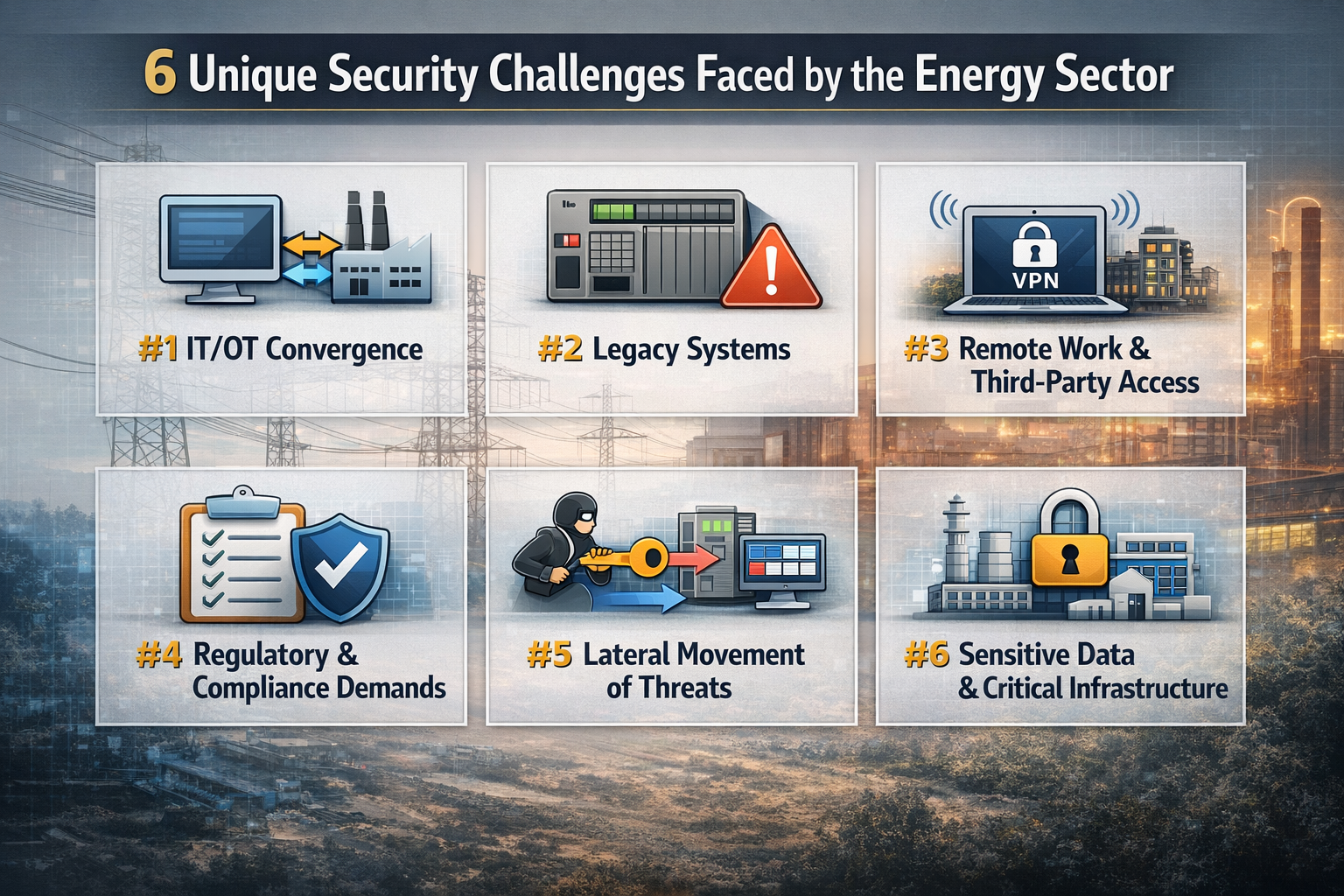
Integrating IT systems with operational technology exposes vulnerabilities such as unencrypted protocols (e.g., Modbus, DNP3), legacy PLCs with default or hardcoded credentials, and a lack of network segmentation. Attackers can exploit these weaknesses to move from business networks into control systems. To address this, deploy protocol-aware firewalls between IT and OT, require device authentication for all cross-domain communications, and use network segmentation to isolate critical OT assets from IT traffic.
Many energy companies operate equipment like remote terminal units (RTUs) and programmable logic controllers (PLCs) that run outdated firmware or unsupported operating systems. These devices may lack basic security features such as logging, encryption, or patch management, making them targets for exploits like CVE-2019-10915. Reduce risk by placing legacy devices on isolated VLANs, applying vendor patches during scheduled maintenance windows, and monitoring device logs for unauthorized changes.
Remote engineers and contractors often connect to SCADA systems or substation controls using VPNs or remote desktop tools. This increases the risk of credential theft, session hijacking, or unauthorized lateral movement. Enforce multi-factor authentication for all remote sessions, restrict access to only the systems required for the user’s role (e.g., limit a contractor’s access to a single substation HMI), and monitor remote session logs for unusual activity or access outside approved hours.
Energy companies must comply with frameworks such as NIST SP 800-82 for OT security and NERC CIP for critical infrastructure protection. These require asset inventories, vulnerability assessments, incident response plans, and audit trails for all access to control systems. Zero trust supports compliance by enforcing least-privilege access, logging every access request, and automating compliance reporting for audits.
Attackers may use compromised user accounts or vulnerable devices to pivot from IT to OT, targeting assets like historian databases or HMI workstations. Limit lateral movement by enforcing strict access controls (e.g., role-based access for SCADA engineers), monitoring for unusual authentication attempts, and using micro-segmentation to isolate critical systems from the rest of the network.
Operational data such as grid telemetry, outage reports, and control commands must be protected from unauthorized access or tampering. Use data loss prevention tools to monitor for unauthorized data transfers, encrypt sensitive data both in transit and at rest, and require role-based access for all control system commands. Regularly audit access logs to detect and investigate suspicious activity.
Read Next: How to Secure Cloud-Native Infrastructure in the Energy Sector
A strong zero-trust architecture for energy companies relies on several key components. Each one plays a specific role in reducing risk, supporting compliance, and enabling secure operations across both legacy and modern systems.
| Component | Risk Addressed in Energy Networks | Implementation Examples |
|---|---|---|
| Identity & Access Management (IAM) | Unauthorized access to SCADA servers, HMIs, engineering workstations, and vendor portals | Named accounts, MFA for VPN/vendor access, role-based access for operators and engineers |
| Network Segmentation | Attackers moving from corporate IT into OT systems like substations or control networks | Industrial DMZs, VLAN separation for IT/OT, firewall rules restricting protocols like RDP or SMB |
| Continuous Authentication & Monitoring | Stolen credentials or suspicious logins from unmanaged devices | MFA re-checks, SIEM monitoring of VPN and admin sessions, alerts for unusual access patterns |
| Least-Privilege Access | Excess permissions allowing contractors or staff to access unnecessary systems | Remove shared admin accounts, restrict vendor access windows, periodic privilege reviews |
| Threat Detection & Response | Ransomware, abnormal PLC commands, or unauthorized engineering workstation activity | SIEM correlation, OT monitoring tools, and incident playbooks for compromised control systems |
| Secure Remote Access | Contractor laptops or exposed RDP sessions accessing critical infrastructure | ZTNA or jump hosts, MFA, session recording for vendor maintenance access |
| Policy-Based Access Control | Static access rules that ignore role, device health, or maintenance schedules | Context-based policies (role, device, location), automated access enforcement |
| Legacy System Integration | Older PLCs, RTUs, or relays that lack modern authentication or patching | Network isolation, jump servers, allow-listing, protocol gateways |
Moving to zero trust requires a structured approach that addresses both technical and organizational challenges. Each step should be tailored to the unique needs of energy companies, ensuring that security measures are both effective and sustainable.
Read Next: Shadow AI: Things to Consider When Your Executive Team is Feeling Vibe-y
As energy companies mature in their zero-trust journey, they are turning to advanced security tools and automation to close gaps that traditional controls can’t address. The need for real-time visibility, rapid response, and proactive risk management is driving the adoption of new technologies across both IT and OT environments. By integrating these advanced measures, organizations can better anticipate threats, streamline operations, and maintain compliance as the regulatory landscape evolves.
Read Next: How to Evaluate Top AI Consulting Firms for Enterprise Impact
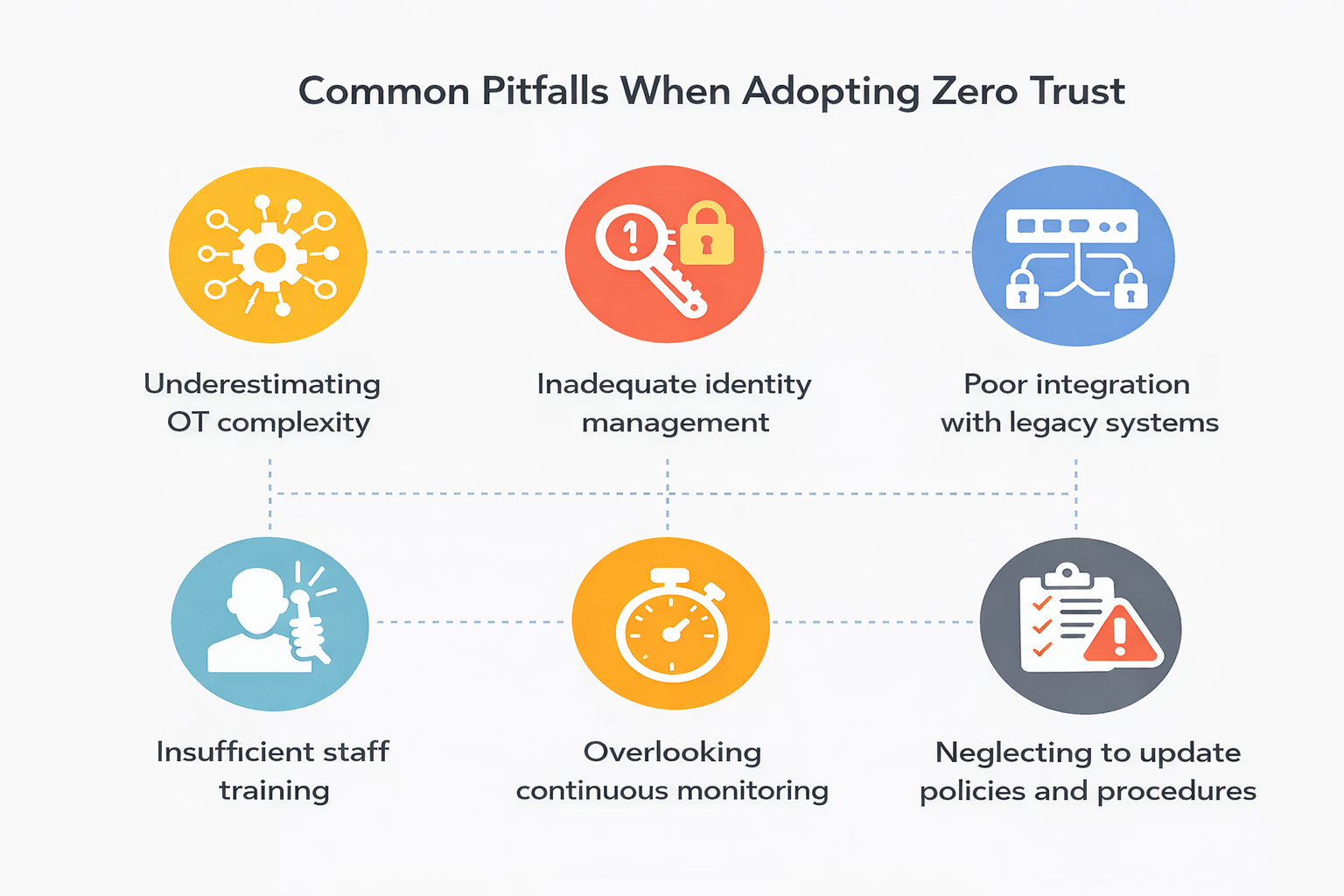
Energy companies often encounter specific challenges when implementing zero-trust architecture. Recognizing these pitfalls early and addressing them with targeted strategies can make the difference between a successful rollout and a stalled initiative.
| Pitfall | Why It Happens | How to Avoid It |
|---|---|---|
| Underestimating OT complexity | OT networks often use proprietary protocols (e.g., IEC 61850, DNP3) and legacy devices that lack modern security features, making IT-centric solutions ineffective | Involve OT engineers in security planning, use protocol-aware firewalls, and select ZTA tools that support industrial protocols and legacy device integration |
| Inadequate identity management | Many OT devices lack unique credentials or use shared accounts, leading to weak authentication and poor auditability | Deploy identity and access management (IAM) platforms that support device certificates, enforce unique credentials for all users and devices, and regularly audit account usage |
| Poor integration with legacy systems | Legacy PLCs and RTUs may not support encryption or modern authentication, leaving them exposed to attacks like replay or man-in-the-middle | Use protocol gateways to add encryption, segment legacy devices on isolated VLANs, and schedule regular firmware updates during planned outages |
| Insufficient staff training | OT staff may not be familiar with cybersecurity best practices, leading to risky behaviors like sharing passwords or ignoring alerts | Provide hands-on training on secure device configuration, incident response, and phishing detection; conduct regular drills and update training based on real incidents |
| Overlooking continuous monitoring | Without real-time monitoring, attacks such as unauthorized firmware uploads or lateral movement can go undetected for weeks | Deploy SIEM and OT-specific monitoring tools, set up alerts for configuration changes, and review logs daily for signs of compromise |
| Failing to align with compliance requirements | Security controls that don’t map to NERC CIP or NIST SP 800-82 can result in audit failures and regulatory penalties | Map every ZTA control to specific compliance requirements, use automated compliance reporting, and maintain documentation for all security changes |
| Neglecting to update policies and procedures | Static policies may not address new threats like supply chain attacks or cloud-based OT management | Review and update security policies every six months, include scenarios for new technologies, and involve both IT and OT leadership in policy approval |
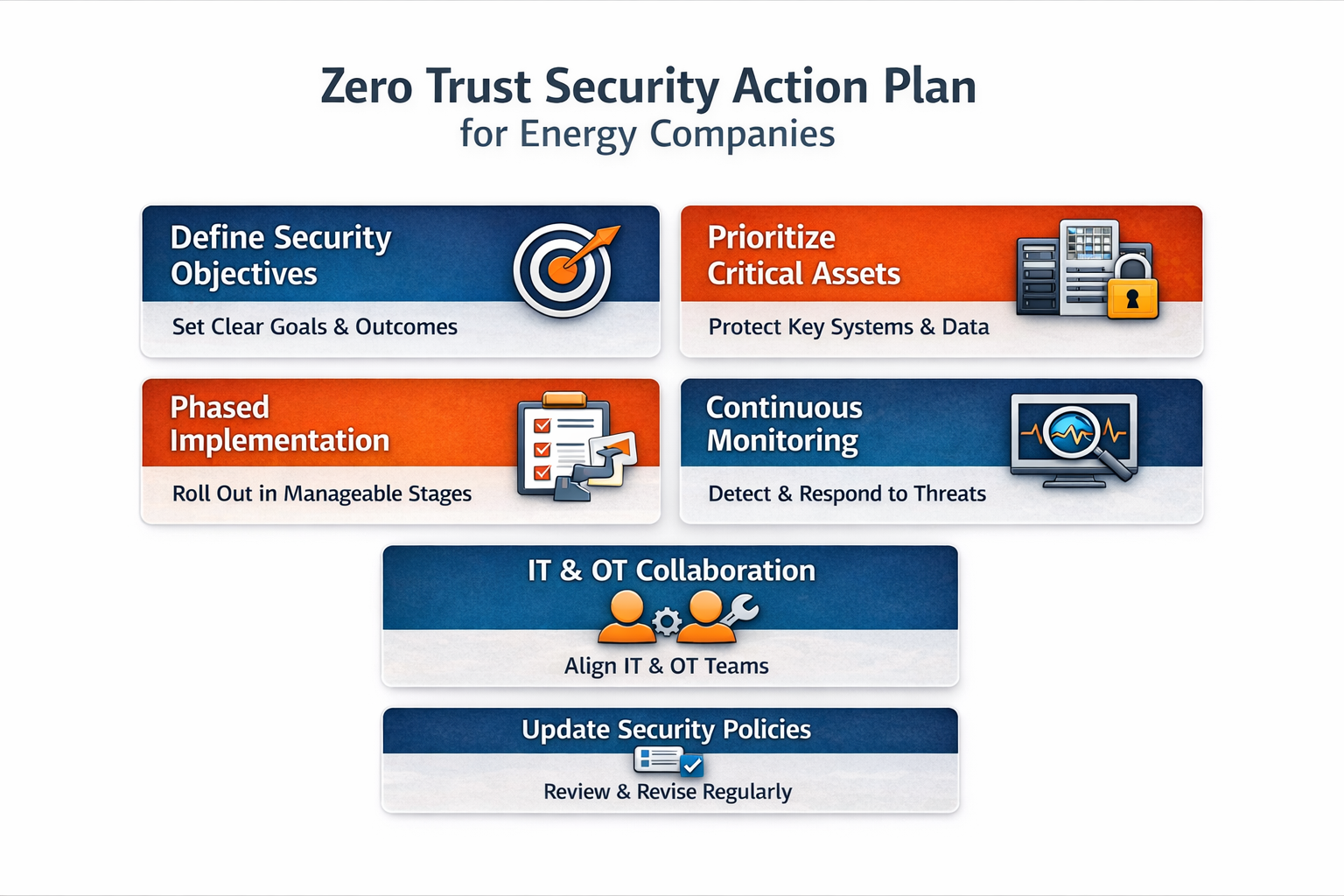
Building a zero-trust security model in the energy sector requires more than just technology. It takes a clear vision, strategic prioritization, and a commitment to continuous improvement. Each step in the action plan below is designed to help organizations move from theory to practice, ensuring that security measures are both effective and sustainable.
Zero-trust architecture is becoming the standard for cybersecurity in the energy sector. By moving beyond traditional perimeter defenses and embracing continuous verification, energy systems can build resilience against evolving threats and regulatory demands.
The journey to zero trust is complex, but with a clear roadmap, cross-functional collaboration, and a commitment to continuous improvement, organizations can achieve a security posture that supports both operational excellence and long-term sustainability.
As organizations look to strengthen their security posture, working with a partner that blends cloud engineering, security, and operational expertise can provide clarity and confidence. Serverless Solutions focuses on delivering continuous monitoring, rapid incident response, and zero-trust-based controls designed for the unique demands of critical infrastructure.
Book a strategy session to discover how a security-first approach and dedicated security operations team can help you implement zero trust architecture and protect your most valuable assets.
Zero trust architecture is a security model that requires every user, device, and system to be authenticated and authorized before accessing resources, regardless of their location. For energy companies, this approach is crucial because it addresses the expanded attack surface created by IT/OT convergence, remote work, and legacy systems, ensuring that critical infrastructure and sensitive data are protected from both internal and external threats.
Traditional security models rely on a trusted network perimeter, assuming that anything inside the network is safe. Zero trust, on the other hand, treats every access request as potentially risky and requires continuous verification. This shift is especially important for energy companies, where distributed assets and remote access make perimeter-based defenses inadequate.
The main challenges include integrating legacy OT systems that may not support modern security protocols, managing identities across diverse environments, and ensuring that staff are trained to follow new security procedures. Addressing these challenges requires specialized tools, cross-functional collaboration, and a phased implementation strategy.
Zero trust aligns with frameworks like the NIST cybersecurity framework by emphasizing continuous monitoring, least-privilege access, and rigorous authentication. By documenting controls and aligning policies with regulatory standards, energy companies can demonstrate compliance and reduce the risk of audit failures.
Start by assessing your current security posture, mapping data flows and access points, and identifying critical assets. From there, establish strong authentication protocols, enforce least-privilege access, and deploy continuous monitoring tools. Training staff and aligning with compliance frameworks are also essential early steps.
Zero trust provides OT environments with enhanced security by ensuring that only authenticated and authorized users and devices can access control systems and sensitive data. This reduces the risk of lateral movement by attackers and helps protect critical infrastructure from both targeted and opportunistic threats.

1 min read
What Is the Entra Suite? Microsoft’s Entra Suite is for organizations seeking robust security solutions. Released recently, it brings together a...
1 min read
Microsoft has completed the acquisition of Miburo, a cyber threat analysis and research company. Miburo specializes in cyber threats from nation...

6 min read
Enterprise AI strategies keep failing. Not because of weak vision, but because the fundamentals get ignored. Strategies collapse when disconnected...