15 min read
Why Energy Companies Can’t Afford to Keep IT and OT Security Separate
Energy companies now face a security problem that didn't exist a decade ago. The systems that run business operations and the systems that control...
14 min read

Serverless computing changes how applications run, but it doesn't eliminate the security work required to protect them. In regulated industries, the shift from virtual machines to serverless functions introduces new risks around identity and access, API exposure, data flows across managed cloud services, third-party dependencies, and compliance evidence collection.
Serverless platforms like AWS Lambda, Azure Functions, and Google Cloud Functions reduce infrastructure management, but they do not make application security automatic. Verizon’s 2025 Data Breach Investigations Report found that about 88% of Basic Web Application Attack breaches involved stolen credentials, underscoring why identity, access control, and API protection remain critical even when infrastructure is managed by the cloud provider.
Teams are still responsible for IAM, authentication, authorization, encryption, logging, and threat detection. In regulated industries, serverless security needs controls designed for short-lived workloads and distributed systems, where traditional tools like firewalls and VM agents may not apply.
This guide covers:
How the shared responsibility model shifts security accountability in serverless environments without eliminating customer obligations
The core risks that emerge when securing serverless applications across identity, APIs, data, dependencies, and compliance
Security controls regulated teams should prioritize to protect serverless workloads without blocking deployment velocity
P.S. Serverless security requires continuous visibility across functions, APIs, identities, and cloud services. Serverless Solutions provides Managed Security Services with 24×7 monitoring, rapid response, and managed detection and response built for cloud, hybrid, and on-prem environments. The service uses your infrastructure, so you stay in control while gaining enterprise-grade security and continuous visibility. Speak with an advisor to assess where your serverless applications need stronger monitoring, access control, and response coverage.
Serverless shifts infrastructure responsibility but not application security, IAM, data protection, or compliance accountability.
Over-permissive IAM roles create high-impact security risks when functions access sensitive data or cloud services.
APIs become the primary attack surface since serverless applications rely on API Gateway and HTTP triggers.
Third-party dependencies introduce supply chain attacks if packages contain malicious code or known vulnerabilities.
Short-lived serverless functions make threat detection harder without centralized logging and real-time monitoring.
Compliance evidence becomes fragmented across Lambda invocations, API logs, IAM policies, and managed cloud services.
The appeal of serverless computing is simple: no servers to patch, no operating systems to maintain, no infrastructure to scale manually. Your cloud provider handles the runtime environment while your team focuses on writing code that solves business problems. But that convenience doesn't eliminate security responsibility—it shifts it.
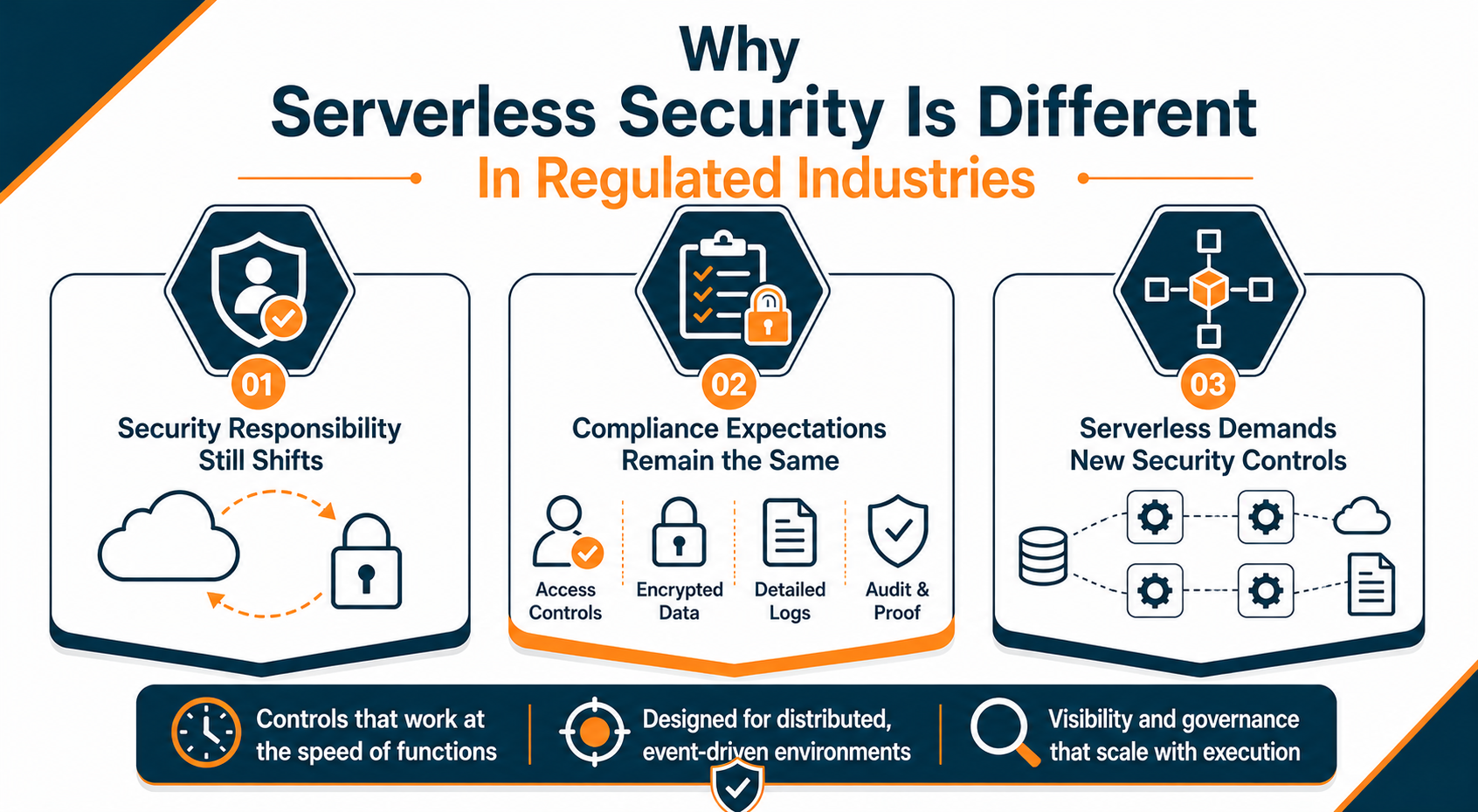
When you deploy a function, you're still accountable for who can access it, what data it touches, how it authenticates users, and whether it meets compliance requirements. The cloud provider secures the infrastructure layer. You secure everything that runs on top of it: the application logic, the permissions model, the API endpoints, the data flows, and the audit trail.
Regulated industries face a specific challenge here. Compliance frameworks don't care whether you're running virtual machines or serverless functions. They still expect strong access controls, encrypted data, detailed logs, and proof that only authorized people can access sensitive information. The difference is that serverless environments distribute work across dozens or hundreds of short-lived functions, each connecting to different cloud services, each generating its own logs, each requiring its own permissions. Traditional security tools built for long-running servers don't fit this model. You need controls that work at the speed of function execution, not the speed of traditional infrastructure monitoring.
Moving to serverless doesn't reduce your attack surface—it changes it. Instead of worrying about server patches and network firewalls, you're managing identity permissions, API security, data encryption across multiple services, and compliance evidence scattered across different log streams. Each of these areas introduces risk if not handled correctly.
Your cloud provider secures the platform. You secure the workload. That division sounds clear until you start asking specific questions: Who's responsible for encrypting data? Who controls access to the function? Who ensures logs are retained for compliance?
The answer is almost always you. The provider makes sure the function runtime is patched and available. They protect the underlying infrastructure from attacks. But they don't configure your permissions, encrypt your data by default, or set up your logging. Those are customer responsibilities, and in regulated industries, getting them wrong creates compliance risk.
Teams that assume "managed service" means "fully secured service" often discover gaps during audits. Auditors want to see proof that sensitive data is encrypted, that access is restricted to authorized users, and that every action is logged. If you haven't configured those controls, the fact that your provider manages the infrastructure doesn't matter.
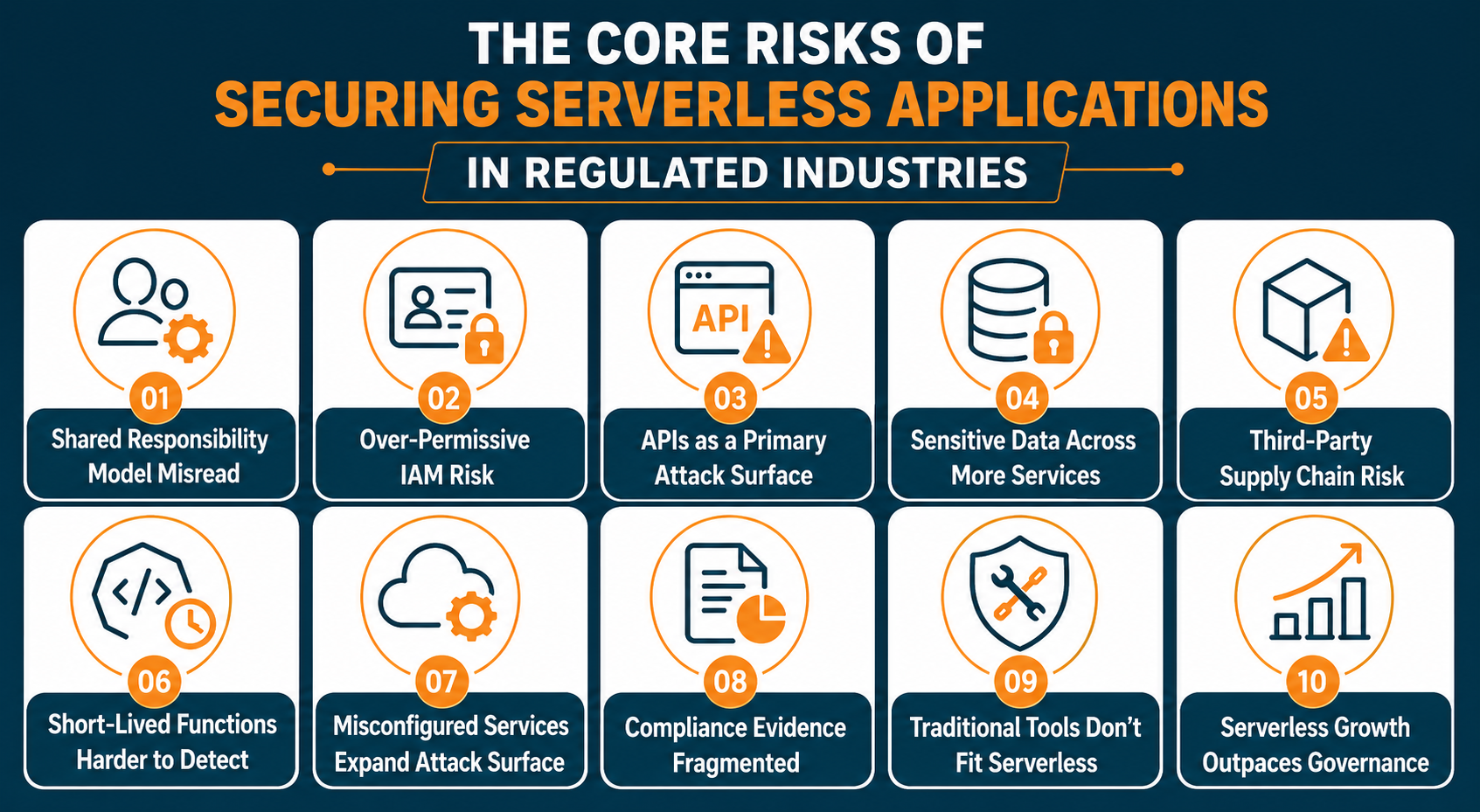
Every function needs permission to do its job. A function that processes customer orders might need to read from a database, write to a storage bucket, and send a notification. Those permissions are controlled through identity and access management policies, and this is where many serverless security problems start.
When permissions are too broad, a compromised function can do more damage than it should. If a function only needs to read one specific database table, but you've given it access to the entire database, an attacker who exploits that function gains access to everything. The same problem appears when teams reuse the same permission set across multiple functions to save time. One vulnerability now affects every function using those permissions.
Overly Broad Roles: Giving a function full access to a storage service when it only needs to read from one folder creates unnecessary risk if that function is exploited.
Reused Service Accounts: Using the same identity across multiple functions means a vulnerability in one function exposes all the resources that the identity can access.
Missing Least Privilege Enforcement: Compliance frameworks require granting only the permissions necessary to complete a task, but serverless environments often start with broad permissions that never get tightened.
Permission Drift Over Time: As applications evolve, permission sets accumulate access rights that are no longer needed, expanding risk without adding value.
Read Next: Microsoft Entra Suite: Simplified Zero Trust Security
Most serverless applications expose their functions through APIs. A user makes a request, the API routes it to the right function, the function processes it, and the result comes back. That API endpoint is now your front door, and if it's not properly secured, anyone who finds it can walk through.
Simple API keys aren't enough for regulated workloads. Keys can be leaked, hardcoded into client applications, or intercepted. They don't identify individual users, can't be revoked selectively, and don't support role-based access. You need authentication that proves who the user is and authorization that checks whether they're allowed to perform the requested action.
Without these controls, your API becomes vulnerable to unauthorized access, data scraping, injection attacks, and abuse. Rate limiting helps prevent someone from overwhelming your system with requests. Input validation blocks malicious payloads that try to exploit vulnerabilities in your code. Logging every request creates an audit trail that shows who accessed what and when. These aren't optional features—they're baseline requirements for securing APIs in regulated environments.
Read Next: Improving Reliability with Azure API Management
A single transaction in a serverless application might touch multiple cloud services. The function reads data from a database, writes results to a storage bucket, sends a message to a queue, and logs activity to a monitoring service. Each of these steps involves sensitive data moving between systems, and each step needs protection.
Data in transit needs encryption to prevent interception. Data at rest needs encryption to protect it if the storage is accessed without authorization. Temporary data held in function memory during execution can leak through error messages or logs if not handled carefully. And if your application replicates data across regions for availability, you need to control where that data lives to meet compliance requirements around data residency.
Data Moving Between Services: Information traveling from a function to a database, storage bucket, or messaging queue needs encryption to prevent interception during transit.
Data Stored In Cloud Services: Databases, storage buckets, and file systems used by serverless applications should encrypt data at rest, ideally using keys you control rather than provider-managed defaults.
Temporary Data In Function Memory: Functions may hold sensitive information in memory while processing requests, and poor coding practices can expose that data through logs or error messages.
Cross-Region Data Flows: Cloud platforms can replicate data across regions automatically, but regulated industries need to control where data resides to meet legal and compliance requirements.
Read Next: New Protections for AI Data: Microsoft Purview Just Got Smarter
Functions rarely work in isolation. They rely on libraries, frameworks, and packages to handle authentication, data processing, API calls, and business logic. Every one of those dependencies is a potential security risk. A malicious package can steal credentials, exfiltrate data, or create backdoors. An outdated library with known vulnerabilities can be exploited if not patched.
The problem is that serverless applications bundle these dependencies into deployment packages, and if those packages aren't scanned or validated, vulnerable code moves straight into production. Once deployed, functions scale automatically, so a compromised dependency can spread across thousands of executions before anyone notices.
Regulated teams need processes that scan dependencies for vulnerabilities, validate packages before deployment, and enforce policies that prevent using libraries with known security issues. Supply chain security isn't just about your code—it's about everything your code relies on.
Traditional security monitoring assumes workloads run for hours or days. You can track user sessions, analyze network traffic over time, and watch for patterns that indicate compromise. Serverless functions don't work that way. They execute for seconds or milliseconds, complete their task, and terminate.
A malicious invocation can finish, steal data, and disappear before detection tools notice anything unusual. Without centralized logging that captures every function execution, API call, and data access event in real time, security teams can't see what's happening. They can't correlate activity across functions, identify patterns that suggest an attack, or respond before damage spreads.
Detection in serverless environments requires logging everything, centralizing those logs in a system where they can be searched and analyzed, and monitoring for unusual patterns as they happen—not hours or days later.
Functions connect to databases, storage buckets, messaging queues, and other managed services. Each of these services has its own security settings, and misconfigurations create risk even if the function itself is secure.
Publicly Accessible Storage: A storage bucket configured to allow public read access exposes sensitive data regardless of how well the function is secured.
Unencrypted Databases: Databases that don't encrypt data at rest leave information vulnerable if credentials are compromised or access controls fail.
Weak API Gateway Policies: API configurations that allow unauthenticated access or don't enforce rate limits create opportunities for abuse and data theft.
Missing Logging On Services: Cloud services that don't send logs to a central system prevent security teams from detecting unauthorized access or configuration changes.
Read Next:
Auditors want to see proof that your security controls work. They need logs showing who accessed what data, when, and why. They need evidence that sensitive information is encrypted. They need documentation proving that only authorized users can invoke functions.
In serverless environments, that evidence is scattered. Function execution logs live in one place. API access logs live in another. Permission changes are tracked separately. Cloud service activity generates its own logs. Without a centralized system that collects and correlates all of this information, proving compliance becomes a manual, time-consuming process.
Regulated teams need logging strategies that capture everything, retain logs for the required period, and make them searchable so auditors can find the evidence they need without digging through dozens of separate log streams.
Security tools built for virtual machines and on-premises servers often don't work in serverless environments. The table below shows where traditional controls fall short and what regulated teams need instead.
| Traditional Control | Serverless Security Gap | What Regulated Teams Need Instead |
|---|---|---|
| VM agents | No persistent infrastructure to install monitoring agents | Cloud-native security services that monitor function invocations, API calls, and permission usage |
| Network firewalls | Functions don't run behind traditional network perimeters | API-level security policies, identity-based access control, and cloud-native network segmentation |
| Server patching | Cloud provider manages runtime updates | Dependency scanning, vulnerability management for application code, and secure coding practices |
| Manual reviews | Functions deploy too quickly for manual security checks | Automated security scanning in deployment pipelines, policy enforcement as code, and continuous compliance validation |
| Perimeter defense | Serverless architecture has no fixed perimeter to defend | Zero-trust security model with identity-based access, API authentication, and least privilege permissions |
Deploying a new function takes minutes. Connecting it to other services takes a few more clicks. Scaling it to handle thousands of requests happens automatically. That speed is valuable, but it creates governance risk when functions are deployed without security review, permissions are copied without validation, or APIs are exposed without authentication.
Unmanaged Deployments: Development teams can deploy functions directly to the cloud without central IT visibility, creating workloads that bypass security controls.
Inconsistent Security Standards: Without governance frameworks, different teams apply different security practices, leading to gaps in encryption, logging, access control, or vulnerability management.
Loss of Centralized Visibility: Serverless environments can grow to hundreds or thousands of functions, and without centralized monitoring, security teams lose track of what's running, who has access, and where sensitive data flows.
Compliance Drift: Applications that start compliant can drift out of compliance as functions are updated, permissions change, or new services are added without security review.
Protecting serverless applications requires controls that fit distributed, API-driven workloads. The goal is to secure identity, access, data, and compliance evidence without blocking the speed and scalability that make serverless valuable.
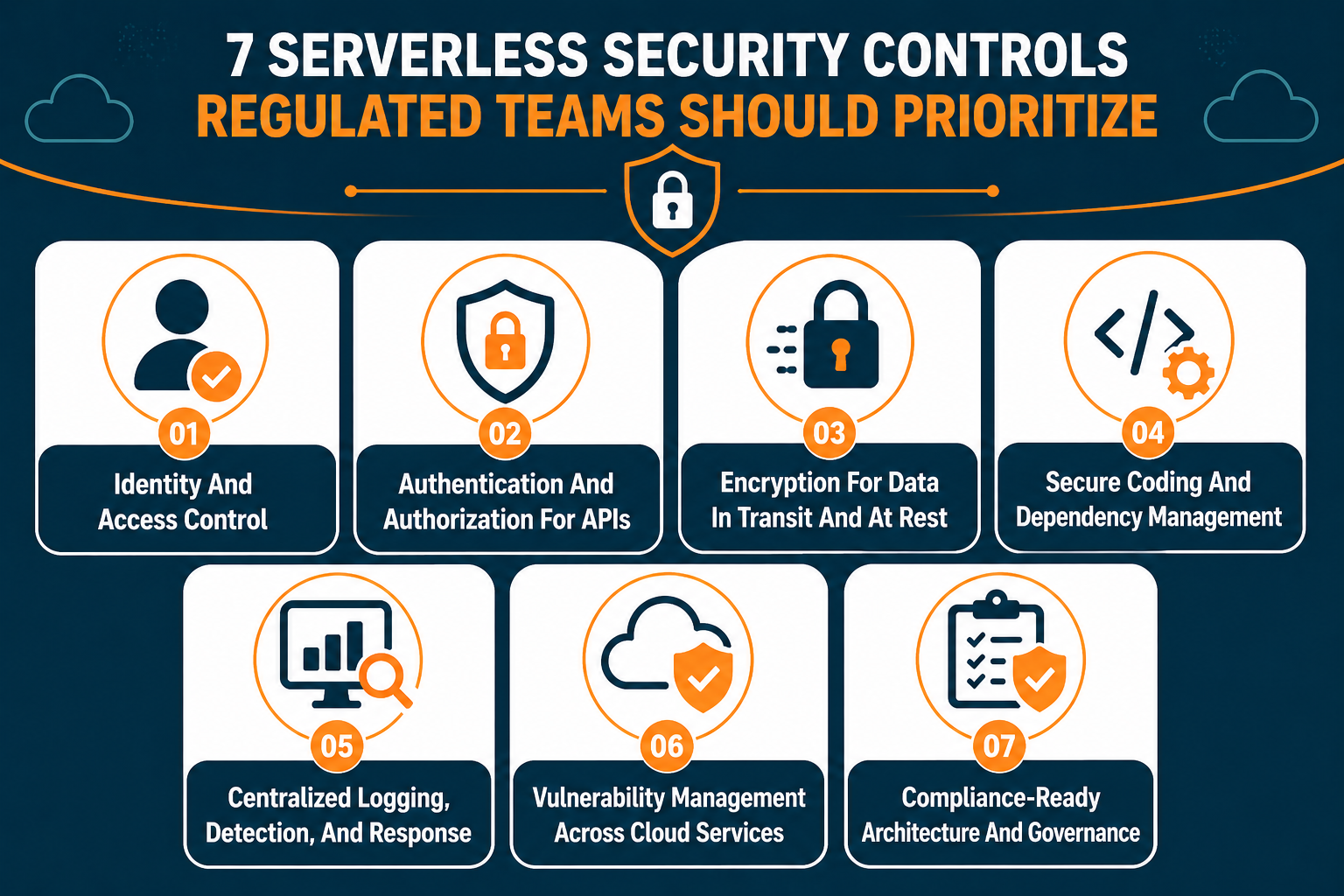
Permissions are the foundation of serverless security. Every function needs a defined set of permissions that control what it can access, and those permissions should be as narrow as possible. A function that reads customer data from a database should have read-only access to the specific table it needs—not full access to every table in the system.
The principle of least privilege means granting only what's necessary to complete the task. Nothing more. Regulated teams should audit permissions regularly, remove access that's no longer needed, and enforce role-based access control that aligns with compliance requirements. Identity and access management isn't optional in serverless environments—it's the primary mechanism that prevents unauthorized access to sensitive data and cloud services.
APIs are the entry point to serverless applications, and they need strong authentication and authorization. Authentication proves who the user is. Authorization checks whether they're allowed to perform the requested action.
Token-Based Authentication: Use authentication methods that identify individual users, support role-based access, and integrate with your existing identity systems rather than relying on simple API keys.
API Gateway Policies: Configure your API management layer to enforce authentication before invoking functions, and use authorization policies that check user roles or permissions.
Rate Limiting: Protect APIs from abuse by limiting how many requests a single user or IP address can make in a given time period, reducing the risk of denial-of-service attacks or data scraping.
Input Validation: Validate all API inputs to block injection attacks, malicious payloads, or unexpected data that could exploit vulnerabilities in your function code.
Regulated industries require encryption to protect sensitive data from unauthorized access. Data moving between your API, functions, and cloud services should be encrypted in transit. Data stored in databases, storage buckets, or file systems should be encrypted at rest.
Using encryption keys you control gives you authority over key rotation, access policies, and audit trails. Encryption alone doesn't prevent all attacks, but it ensures that even if data is accessed without authorization, it remains protected from disclosure. Treat encryption as a baseline control, not an optional feature.
Functions are still code, and code can have vulnerabilities. Secure coding practices reduce the risk of injection attacks, logic flaws, and data leaks.
Input Validation: Validate and sanitize all inputs to prevent attacks that exploit function logic through malicious data.
Error Handling That Protects Sensitive Data: Avoid logging sensitive information in error messages, stack traces, or debug output that could be accessed by unauthorized users.
Dependency Scanning: Scan third-party libraries and packages for known vulnerabilities before deploying functions, and update dependencies regularly to patch security issues.
Software Composition Analysis: Use tools that identify vulnerable or malicious packages in your deployment bundles, and enforce policies that prevent deploying functions with high-severity vulnerabilities.
Functions generate logs for every execution, API call, permission change, and error. Centralized logging collects those logs in a single system where security teams can search, correlate, and analyze activity across the entire environment.
Real-time monitoring detects unusual patterns like repeated failed authentication attempts, unexpected permission changes, or functions accessing sensitive data outside normal business hours. Automated response playbooks can disable compromised functions, revoke permissions, or alert security teams before damage spreads. Centralized logging and detection turn serverless environments from black boxes into observable, auditable systems.
Read Next:
Serverless applications depend on managed cloud services, and those services need security monitoring. Vulnerability management includes scanning function code for security issues, reviewing permissions for overly broad access, checking API configurations for weak authentication, and auditing storage services for public access or missing encryption.
Cloud security posture management tools automate these checks, identify misconfigurations, and provide remediation guidance. Regulated teams should run vulnerability scans continuously, not just during deployment, because serverless environments change frequently as functions are updated, services are added, and permissions evolve.
Regulated industries need serverless architectures that support compliance from the start. Compliance-ready design includes centralized logging with long-term retention, encryption for data in transit and at rest, permissions that enforce least privilege, and audit trails that prove who accessed what data and when.
Policy-As-Code: Define security and compliance policies as code that can be tested, versioned, and enforced automatically during deployment, reducing the risk of manual configuration errors.
Automated Compliance Checks: Use tools that validate serverless configurations against compliance frameworks and flag violations before functions reach production.
Centralized Governance Frameworks: Establish processes that define how functions are deployed, who can create permissions, what logging is required, and how security reviews are conducted.
Audit-Ready Documentation: Maintain documentation that shows how serverless applications meet compliance requirements, including architecture diagrams, data flow maps, permission policies, and evidence of security testing.
Serverless security requires different controls than traditional infrastructure. The table below compares how security changes when moving from virtual machines and on-premises servers to serverless computing.
| Security Area | Traditional Environment | Serverless Environment | Regulated-Industry Priority |
|---|---|---|---|
| Infrastructure | Patch servers, manage operating systems, and configure firewalls | Cloud provider manages runtime, no OS access | Focus shifts to application security, permissions, and API protection |
| Access Control | Network segmentation, VPN, firewall rules | Identity-based permissions, API authentication, and least privilege | Identity becomes the primary security boundary |
| Application Entry Points | Load balancers, web servers, and network firewalls | API gateways, HTTP triggers, event sources | APIs need strong authentication, authorization, and input validation |
| Threat Detection | VM agents, network monitoring, intrusion detection systems | Centralized logging, cloud-native detection, and real-time monitoring | Logs must be centralized and correlated across functions and services |
| Data Protection | Encrypt at rest on servers, use TLS for network traffic | Encrypt in transit and at rest across managed services | Customer-managed keys and data flow visibility are critical |
| Vulnerability Management | Patch servers, scan VMs, update software | Scan function code, review permissions, and audit cloud service configurations | Continuous scanning and policy enforcement replace periodic patching |
| Compliance Evidence | Server logs, firewall logs, access records | Function logs, API logs, permission audit trails, cloud service logs | Centralized logging and long-term retention are required for audit readiness |
Read Next: SaaS Security Posture Management Expanded in Microsoft Defender
Serverless applications change constantly. Functions are updated. Services are added. Permissions evolve. Security controls that work at deployment can drift out of compliance as the environment grows. Regulated teams need continuous visibility into serverless workloads, not one-time security reviews.
That means centralized logging that captures every function execution, real-time monitoring that detects unusual activity, automated compliance checks that validate configurations against policies, and governance frameworks that enforce security standards across all deployments. Securing serverless applications in regulated industries is an ongoing process that adapts as the application, the threat landscape, and compliance requirements change.
Key Takeaways:
Serverless security depends on identity and access control, API authentication, encryption, centralized logging, and continuous vulnerability management.
Traditional security tools built for virtual machines don't fit serverless workloads, and regulated teams need cloud-native controls instead.
Compliance evidence in serverless environments requires centralized logging, long-term retention, and audit-ready documentation that proves security controls are effective.
Serverless computing offers speed, scalability, and reduced infrastructure overhead, but it doesn't eliminate security responsibility. Regulated industries need security strategies that protect applications without blocking deployment velocity.
Serverless Solutions provides Managed Security Services with 24×7 monitoring, rapid response, and managed detection and response built for cloud, hybrid, and on-prem environments. The service uses your infrastructure, so you stay in control while gaining enterprise-grade security and continuous visibility across serverless workloads, APIs, identities, and cloud services. Speak with an advisor to evaluate your serverless security posture and strengthen detection, access control, and response coverage.
Serverless security protects applications by securing identity and access control, API authentication, data encryption, third-party dependencies, logging, and compliance evidence. It focuses on application-layer security instead of infrastructure-layer controls like firewalls or VM agents.
Regulated industries need strong access control, audit trails, data protection, and compliance evidence. Serverless environments distribute workloads across functions and managed cloud services, making it harder to centralize logs, enforce least privilege, and prove compliance without cloud-native security controls.
The biggest risks include overly broad permissions, weak API authentication, unencrypted sensitive data, vulnerable third-party dependencies, misconfigured cloud services, and fragmented compliance evidence. Short-lived functions also make threat detection harder without centralized logging.
Secure functions by enforcing least privilege permissions, using strong API authentication, encrypting data in transit and at rest, scanning dependencies for vulnerabilities, centralizing logs, and monitoring for unusual activity. Each cloud provider offers native security tools, but regulated teams need additional controls for compliance.
The shared responsibility model means the cloud provider secures the infrastructure, runtime, and availability, while customers secure the application code, permissions, API authentication, data encryption, logging, and compliance controls. Regulated teams are responsible for application security even though they don't manage servers.
Maintain compliance by centralizing logs, encrypting sensitive data, enforcing least privilege permissions, auditing cloud service configurations, retaining logs for the required period, and documenting how applications meet compliance requirements. Automated compliance checks and policy enforcement as code reduce manual effort and configuration drift.

15 min read
Energy companies now face a security problem that didn't exist a decade ago. The systems that run business operations and the systems that control...

6 min read
Cloud-native adoption is accelerating across the energy sector, but security hasn’t kept pace. In 2024, the average cost of a data breach in energy...

11 min read
Buying more tools doesn't create a strategy. A cybersecurity strategy for critical infrastructure starts with governance, not technology. It defines...