14 min read
7 Best Practices for Securing Serverless Applications in Regulated Industries
Serverless computing changes how applications run, but it doesn't eliminate the security work required to protect them. In regulated industries, the...
15 min read

Energy companies now face a security problem that didn't exist a decade ago. The systems that run business operations and the systems that control physical equipment are kept separate. IT handled data and applications. Operations handled power generation, grid management, and industrial equipment. Each side had its own network, its own team, and its own security approach.
That separation is gone. Remote monitoring tools connect control equipment to cloud platforms. Engineers access industrial systems through corporate networks. Vendors log in remotely to perform maintenance. Data from operational equipment flows into business analytics systems. These connections create value, but they also create risk. Attackers who compromise business systems can now reach the equipment that keeps the lights on.
IT teams and operations teams having different approaches to security complicates it further. IT prioritizes protecting data and updating systems quickly. Operations prioritizes keeping equipment running safely without interruption. When these teams don't align, gaps appear—incomplete visibility, conflicting priorities, and response plans that don't account for what happens if you shut down the wrong system.
This guide covers:
Why connecting business and operational systems creates security risks that neither team can handle alone
The most common gaps between IT and operations security, from visibility to response planning
How to align teams, tools, and controls without creating downtime or safety issues
Practical steps that strengthen security while respecting the constraints of operational environments
P.S. Aligning IT and operations security requires continuous monitoring across both environments. Serverless Solutions provides Managed Security Services for cloud infrastructure, endpoints, networks, identities, and critical systems. The service includes 24/7 security monitoring, threat detection, rapid response, and incident response. The approach combines security tooling, expert analysts, intelligent alert triage, automated response, and human-led investigation and integrates with existing cloud platforms, IT operations, and compliance requirements.
Book a call to evaluate IT/OT visibility gaps and strengthen monitoring across cloud, endpoints, identities, and critical systems.
Connecting business and operational systems creates shared risks that neither IT nor operations can manage alone.
Most energy companies have incomplete visibility into what's connected and limited monitoring across both environments.
Strong alignment requires shared decision-making, complete asset lists, and network boundaries designed around operational risk.
Response plans must account for what happens if you isolate equipment that can't be shut down safely.
Security metrics should measure operational impact, not just how many vulnerabilities exist or boxes get checked.
Continuous monitoring across both environments improves detection speed, response effectiveness, and long-term resilience.
IT and operations teams operate with different assumptions, tools, and priorities. These differences create gaps that weaken overall security and leave energy operations exposed. Understanding where these gaps appear makes it easier to build alignment without disrupting operations.
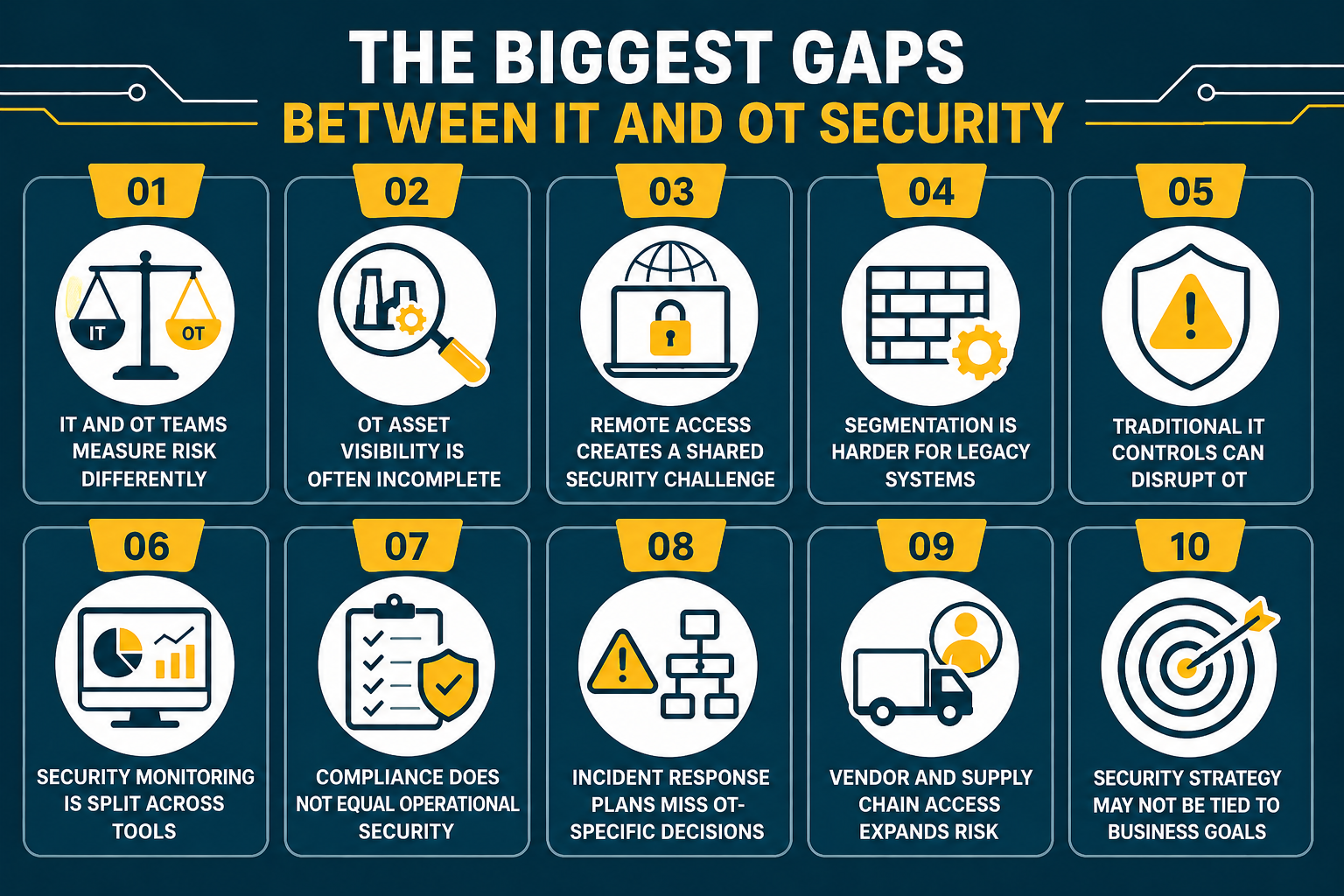
IT teams typically evaluate risk by looking at vulnerability scores, how quickly systems can be patched, and threat intelligence about active attacks. The focus is on reducing weaknesses that attackers could exploit and preventing data breaches. Operations teams evaluate risk differently. They prioritize keeping equipment running, maintaining operational continuity, and ensuring safety. A vulnerability that IT considers urgent may not be actionable in operations if fixing it requires shutting down equipment or could destabilize a control system.
This creates friction. IT teams push for immediate fixes. Operations teams resist changes that could affect reliability. Without a shared way to evaluate risk, security decisions become reactive, inconsistent, and disconnected from what the business actually needs.
Strong alignment requires evaluating risk based on both how easily something can be exploited and what happens if it is. Energy companies need to prioritize based on which assets are most critical, what's exposed, what the consequences could be, and what other protections are available. This allows both teams to focus on the same risks using criteria that reflect operational reality.
Read Next: Rethinking Cybersecurity: Turning Risk Into Strategy in the Energy Sector
Many energy companies don't have a complete list of what's connected to operational networks. Legacy equipment may not work with modern discovery tools. Some devices were installed decades ago and lack current documentation. Others connect intermittently or use proprietary communication methods that standard IT security tools can't read.
Undocumented Equipment: Legacy operational systems, field devices, and industrial equipment often lack current records or detailed documentation.
Proprietary Communication Methods: Many operational devices use specialized protocols that standard IT security tools can't monitor or inventory.
Unofficial Connections: Remote access tools, vendor connections, and temporary integrations may bypass formal tracking processes entirely.
Intermittent Connectivity: Some operational assets only connect to the network during maintenance windows, making continuous visibility difficult.
Remote access is one of the most common ways business and operational environments intersect. Engineers need remote access to troubleshoot control systems. Vendors need access for maintenance and support. Cloud platforms need access to pull real-time data from operational networks.
Each remote access path creates risk. Weak passwords, unmonitored sessions, and overly broad access permissions give attackers a way into operational environments. Once inside, attackers can move to other systems, gain higher privileges, and compromise critical equipment.
IT teams typically manage remote access using virtual private networks, identity systems, and endpoint security tools. Operations teams may rely on vendor-specific remote access solutions that don't integrate with IT security controls. This creates blind spots. Security teams can't see who's accessing operational systems, what they're doing, or whether sessions are being monitored.
Read Next: IT Due Diligence: Zero Trust Architecture for Energy Companies
Network boundaries are a foundational security control, but they're harder to implement when business and operational systems converge. Many operational networks were designed for flat connectivity, not strict boundaries. Legacy systems may not support modern network protocols. Some devices require direct communication with multiple systems, making strict separation impractical.
IT teams often approach network boundaries using virtual networks, firewalls, and zero-trust principles. Operations teams need boundaries that don't break operational workflows, disrupt real-time communication, or require changes to legacy systems that can't be easily reconfigured.
Without careful planning, creating network boundaries can cause operational problems. Control systems may lose connectivity. Data flows may break. Maintenance windows may extend because changes require more testing and validation.
Effective network boundaries in energy environments require understanding operational dependencies, mapping data flows, and designing separation around operational risk rather than just network design.
IT security controls assume systems can be patched, rebooted, and updated regularly. Operational environments operate under different constraints. Many operational systems run continuously and can't tolerate interruption. Legacy systems may not support modern security software. Some control systems require vendor approval before any changes.
| Security Control | IT Environment Assumption | OT Environment Concern | Alignment Takeaway |
|---|---|---|---|
| Patch Management | Updates can be tested and deployed within days or weeks. | Updating may require shutting down equipment, vendor validation, and extended testing periods. | Prioritize based on risk and use alternative protections when immediate updates aren't possible. |
| Endpoint Protection | Security software can be installed on all devices without a performance impact. | Some operational devices can't support security software, and performance issues could affect real-time operations. | Use network-based monitoring and boundaries where endpoint software isn't viable. |
| Network Scanning | Active scanning identifies vulnerabilities without disrupting services. | Active scanning can crash legacy operational devices or trigger false alarms in control systems. | Use passive monitoring and coordinate any active scanning with operations teams during maintenance windows. |
| Access Control | Access can be restricted and changed quickly based on role changes. | Operational access often requires continuity, and overly restrictive policies can delay critical maintenance. | Implement least-privilege access with operational exceptions and continuous monitoring. |
| Incident Containment | Isolating compromised systems is the default response to stop threats. | Isolating operational systems can disrupt operations, create safety risks, or cause physical damage. | Pre-define response procedures that account for operational continuity and safety before taking action. |
IT teams typically use security information and event management platforms, endpoint detection tools, and cloud security platforms. Operations teams may use industrial monitoring tools, control system historians, and vendor-specific dashboards. These tools don't always integrate, and security signals often stay siloed.
Separate Dashboards: IT and operations teams monitor different systems using different tools, making it hard to connect events across environments.
Inconsistent Alerting: IT security tools may generate alerts that operations teams don't see, and operational monitoring tools may flag issues that IT teams can't investigate.
Limited Correlation: Without integrated monitoring, security teams can't connect suspicious business system activity to operational network behavior.
Delayed Detection: Attacks that move from business to operational environments may go undetected longer because no single team has visibility into the full attack path.
Read Next: How to Secure Cloud-Native Infrastructure in the Energy Sector
Energy companies face multiple compliance frameworks, including NERC CIP, NIST, IEC 62443, and industry-specific regulations. Compliance matters, but it doesn't always translate into operational security. Compliance frameworks focus on controls, documentation, and audit readiness. Operational security focuses on detection, response, and resilience.
Some energy companies treat compliance as the primary security goal. They implement controls to pass audits but don't build the monitoring, response processes, and continuous improvement that actually reduce cyber risk. This creates false confidence. Compliance boxes get checked, but the organization remains vulnerable to threats that exploit gaps outside the compliance scope.
Strong alignment requires going beyond compliance. Energy companies need to implement controls that support both compliance requirements and operational security. This means building detection capabilities, improving response speed, and continuously monitoring for threats that compliance frameworks may not explicitly address.
Most response plans are written for business environments. They focus on isolating compromised systems, preserving evidence, and restoring services. These plans often don't account for operational-specific decisions, such as whether isolating a control system will disrupt operations, create safety risks, or cause physical damage.
Containment Tradeoffs: Isolating a compromised operational system may stop an attack, but it could also disrupt power generation, grid stability, or critical processes.
Escalation Paths: IT security teams may not know which operational systems require approval before taking containment actions.
Communication Gaps: Response teams may not have direct communication channels with operations staff, plant managers, or safety teams.
Recovery Complexity: Restoring operational systems often requires vendor support, physical access, and validation testing that IT recovery plans don't account for.
Read Next: Cybersecurity Challenges in Distributed Energy Systems: Securing the Smart Grid
Energy companies rely on vendors for maintenance, support, and system updates. Vendors often need remote access to operational systems, and that access creates a security risk. Vendor credentials may be shared, poorly managed, or left active longer than necessary. Some vendors use remote access tools that bypass IT security controls entirely.
Supply chain attacks exploit this access. Attackers compromise vendor systems, steal credentials, and use legitimate remote access paths to enter energy company networks. Once inside, they move laterally, escalate privileges, and target operational systems.
Strong alignment requires treating vendor access as a shared security challenge. Energy companies need to monitor vendor sessions, enforce strong authentication, limit access duration, and ensure that vendor remote access tools integrate with security monitoring platforms.
Read Next: Evaluating Cybersecurity Vendors for Energy Companies & Distributed Energy Systems
Some energy companies build security strategies around compliance, threat intelligence, or technology trends without connecting those strategies to business goals. Security becomes a separate function that operates independently from operational priorities, business continuity planning, and strategic alignment.
This weakens security effectiveness. Security teams implement controls that don't reflect operational risk. Operations teams resist security changes because they don't see how those changes support uptime, reliability, or safety. Executives view security as a cost center rather than a strategic enabler.
Strong alignment requires tying the security strategy to business goals. Energy companies need to define what security is protecting, why it matters, and how security decisions support operational efficiency, resilience, and long-term competitiveness.
Aligning IT and operations security requires more than adding new tools. It requires shared decision-making, joint processes, and controls that respect operational constraints while closing security gaps. The following sections explain how to build that alignment.
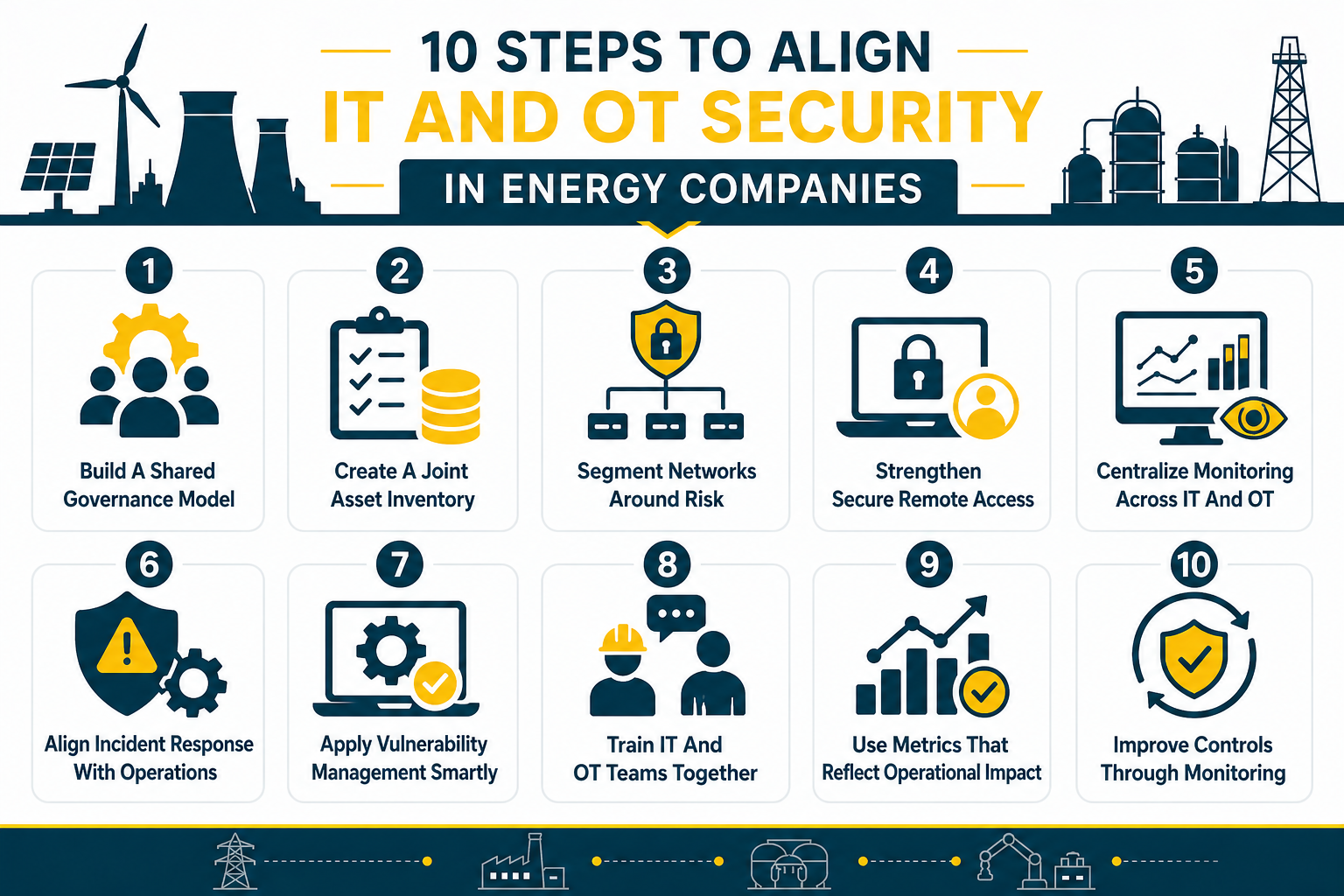
Alignment starts with governance. Energy companies need a governance model that brings IT and operations leaders together to make security decisions, prioritize risks, and allocate resources. This model should define roles, responsibilities, escalation paths, and decision-making authority.
Shared governance doesn't mean IT takes over operations security, or operations teams block every security change. It means both teams have input, both teams understand the tradeoffs, and both teams agree on priorities. Governance meetings should review security metrics, discuss emerging threats, evaluate control effectiveness, and align security investments with business goals.
Effective governance also requires executive sponsorship. Security leaders, IT leaders, and operational leaders need to support alignment efforts, remove organizational barriers, and ensure that security decisions reflect both cyber risk and operational continuity.
Read Next: Rethinking Cybersecurity: Turning Risk Into Strategy in the Energy Sector
Strong alignment requires knowing what assets exist, where they're located, and how they connect. Energy companies need a joint asset inventory that covers both business and operational environments. This inventory should include servers, endpoints, cloud resources, control systems, field devices, remote access tools, and vendor connections.
Automated Discovery: Use network monitoring tools, passive scanning, and cloud asset management platforms to identify business and operational assets automatically.
Manual Documentation: Supplement automated discovery with manual documentation for legacy systems, isolated devices, and proprietary equipment that standard tools can't detect.
Asset Classification: Tag assets based on criticality, operational role, exposure, and security requirements to prioritize monitoring and protection efforts.
Continuous Updates: Treat asset inventory as an ongoing process, not a one-time project, and update records as systems change, new devices connect, or assets are removed.
A complete asset inventory improves visibility, supports risk-based decision-making, and ensures that security controls cover the systems that matter most.
Creating network boundaries reduces what attackers can reach and limits how far they can move. In energy environments, boundaries should be designed around operational risk, not just network design. This means understanding which systems control critical processes, which systems handle sensitive data, and which systems require continuous availability.
Boundary strategies should account for operational dependencies. Some operational systems need direct communication with business systems for data analytics, remote monitoring, or cloud integration. Strict boundaries that break these dependencies will create operational problems. Instead, energy companies should use controlled communication paths, monitored connections, and boundaries that reflect operational workflows.
Effective boundaries also require ongoing validation. As systems change, new devices connect, and operational requirements evolve, boundaries need to be reviewed and adjusted. Security teams should work with operations teams to test boundary changes, validate data flows, and ensure that boundaries don't disrupt operations.
Remote access requires centralized visibility and strong controls. Energy companies should implement secure remote access solutions that support both business and operational environments, enforce strong authentication, monitor sessions, and limit access duration.
Centralized Access Management: Use a single platform to manage remote access for both environments, ensuring consistent authentication, authorization, and monitoring.
Multi-Factor Authentication: Require multi-factor authentication for all remote access, including vendor access, to reduce the risk of stolen credentials.
Session Monitoring: Monitor remote access sessions in real-time, log all actions, and alert security teams to suspicious behavior or policy violations.
Time-Limited Access: Grant remote access for specific time windows and automatically revoke access when sessions end or maintenance windows close.
Strong remote access controls reduce the risk of credential theft, vendor-related attacks, and unauthorized access to operational systems.
Centralized monitoring improves detection speed and helps security teams connect events across business and operational environments. Energy companies should integrate IT security tools, operational monitoring platforms, and cloud security signals into a unified view that supports threat detection, incident response, and continuous improvement.
Centralized monitoring doesn't mean replacing operational-specific tools. It means creating visibility across business and operational signals so security teams can detect threats faster, understand attack paths, and respond before attackers move laterally. This requires integrating security information platforms, endpoint detection tools, network monitoring platforms, and operational-specific monitoring systems.
Effective monitoring also requires intelligent alert prioritization. Security teams should prioritize alerts based on asset criticality, threat severity, and operational impact, reducing noise and ensuring that high-priority threats get immediate attention.
Read Next: How to Secure Cloud-Native Infrastructure in the Energy Sector
Response plans need to account for what happens when you isolate or shut down operational systems. Energy companies should develop response procedures for ransomware, stolen credentials, remote access abuse, vendor compromise, suspicious operational network activity, data loss, and cloud or identity incidents that could affect energy operations.
These procedures should define what actions to take, who needs to approve them, how to communicate during an incident, and how to recover. The key difference from standard IT response plans is that containment decisions must account for operational continuity and safety. Security teams need to know which systems can be isolated, which require escalation, and which need operations approval before action.
For example, isolating a compromised control system may stop an attack, but it could also disrupt grid stability or power generation. Response procedures should define when isolation is appropriate, when alternative protections are better, and when operational continuity takes priority.
Response planning also requires regular testing. Energy companies should run exercises that simulate business and operational incidents, test communication paths, and validate that both IT and operations teams understand their roles during an incident.
Managing vulnerabilities in operational environments requires a different approach than managing vulnerabilities in business systems. Energy companies should use risk-based prioritization, alternative protections, and maintenance coordination to manage vulnerabilities without creating downtime.
Risk-Based Prioritization: Rank vulnerabilities by how easily they can be exploited, which assets they affect, what's exposed, and what the potential operational impact could be.
Compensating Controls: Use network boundaries, monitoring, access restrictions, and detection when immediate patching is not possible due to operational constraints.
Maintenance Coordination: Align remediation with operational windows, vendor requirements, and validation needs to minimize downtime and operational disruption.
Continuous Validation: Monitor patched systems to ensure that updates don't introduce performance issues, compatibility problems, or unintended operational consequences.
This approach reduces cyber risk while respecting the operational constraints that make traditional patch management impractical in operational environments.
IT and operations teams need to understand each other's priorities, constraints, and workflows. Joint training helps both teams build shared knowledge, improve communication, and make better security decisions. Training should cover convergence risks, operational constraints, security controls, response procedures, and real-world attack scenarios.
Energy companies should also run joint exercises that simulate incidents affecting both environments. These exercises help teams practice communication, test response procedures, and identify gaps in coordination before a real incident occurs. Training and exercises should be ongoing, not one-time events, and should evolve as threats, systems, and operational requirements change.
Security metrics should reflect operational impact, not just how many vulnerabilities exist or how many compliance boxes get checked. Energy companies should track metrics that show whether security controls are improving resilience, reducing risk, and supporting operational continuity.
Detection Speed: Measure how quickly security teams detect suspicious activity in business and operational environments, focusing on reducing how long threats go unnoticed.
Response Time: Track how long it takes to contain incidents, escalate threats, and restore normal operations after security events.
Asset Coverage: Monitor the percentage of business and operational assets with active security controls, continuous monitoring, and up-to-date asset records.
Incident Impact: Measure the operational impact of security incidents, including downtime, safety risks, and business continuity disruptions.
Control Effectiveness: Evaluate whether security controls are reducing risk without creating operational problems, and adjust controls based on feedback from operations teams.
These metrics help energy companies understand whether security investments are working and where alignment efforts need improvement.
Continuous monitoring improves detection, response, and long-term resilience. Energy companies should monitor business and operational environments continuously, using automated tools, human-led investigation, and intelligent alert prioritization to identify threats, validate controls, and improve security over time.
Continuous monitoring also supports compliance. Many regulatory frameworks require ongoing monitoring, logging, and threat detection. By integrating continuous monitoring into security operations, energy companies can meet compliance requirements while improving operational security.
Monitoring should cover endpoints, networks, identities, cloud resources, remote access sessions, vendor connections, and operational-specific signals. Security teams should use monitoring data to refine controls, update response procedures, and identify emerging threats before they escalate into incidents.
IT and operations security serve different purposes, but both are essential for protecting energy operations. Understanding the differences helps energy companies build alignment without forcing business system assumptions onto operational environments or leaving operational systems unprotected.
| Area | IT Security Focus | OT Security Focus | Alignment Need |
|---|---|---|---|
| Primary Objective | Protect data confidentiality, integrity, and availability. | Protect uptime, operational continuity, and safety. | Balance data protection with operational reliability and safety requirements. |
| Assets | Servers, endpoints, cloud resources, applications, and data. | Control systems, SCADA, field devices, industrial control systems, and physical processes. | Create a joint asset inventory that covers both environments. |
| Change Management | Frequent updates, patches, and configuration changes. | Infrequent changes, vendor-approved updates, and extended testing windows. | Coordinate changes to avoid operational disruption and ensure validation. |
| Monitoring | Focus on threat detection, endpoint behavior, and cloud security. | Focus on operational performance, system availability, and physical process stability. | Integrate business and operational monitoring signals to detect threats across both environments. |
| Access Control | Role-based access, frequent credential rotation, and least-privilege principles. | Operational access, vendor access, and continuity-focused policies. | Implement least-privilege access with operational exceptions and continuous monitoring. |
| Incident Response | Isolate compromised systems quickly to contain threats. | Evaluate operational impact and safety risks before isolating systems. | Pre-define response procedures that account for operational continuity and safety. |
| Compliance | Focus on data protection, privacy, and IT-specific regulations. | Focus on critical infrastructure protection, safety, and operational regulations. | Align compliance efforts to meet both business and operational regulatory requirements. |
| Resilience | Focus on data backup, disaster recovery, and business continuity. | Focus on uptime, redundancy, and operational continuity during disruptions. | Build resilience strategies that protect both data and operational availability. |
Aligning IT and operations security isn't about forcing business system controls onto operational environments or treating operations as a separate problem. It's about building shared governance, joint processes, and controls that respect operational constraints while closing the gaps that cyber threats exploit. Energy companies that align IT and operations security improve visibility, strengthen resilience, and ensure that security decisions support operational continuity instead of creating downtime.
Shared governance, complete asset lists, and centralized monitoring improve visibility and reduce the gaps between business and operational security.
Response planning, vulnerability management, and remote access controls must account for operational continuity, safety, and business goals.
Security metrics should reflect operational impact, not just compliance boxes, to ensure that security investments support resilience and uptime.
Serverless Solutions provides Managed Security Services that deliver continuous protection for cloud infrastructure, endpoints, networks, identities, and critical systems. The service includes 24/7 security monitoring, threat detection, rapid response, and incident response.
Book a call to evaluate IT/OT security gaps and strengthen monitoring, response, and resilience across critical systems.
IT security protects data confidentiality, integrity, and availability across servers, endpoints, cloud resources, and applications. Operations security protects uptime, operational continuity, and safety across control systems, industrial equipment, and physical processes. IT security prioritizes rapid updates and threat detection. Operations security prioritizes reliability, safety, and minimizing downtime. Strong alignment requires respecting these differences while building shared governance and joint processes.
Connecting business and operational systems creates new attack paths and expands what attackers can reach. Previously isolated operational systems now connect to business networks, cloud platforms, and remote access tools. This gives cyber threats access to control systems and physical processes. Without aligned security, energy companies face incomplete visibility, conflicting priorities, and response plans that don't account for operational continuity. Convergence increases risk when security teams don't have visibility across both environments.
Energy companies monitor operational security using industrial monitoring tools, control system historians, network traffic analysis, and passive monitoring techniques that don't disrupt operations. Many energy companies integrate operational monitoring signals with business security tools to create centralized visibility across both environments. Effective operational monitoring requires understanding operational constraints, avoiding active scanning that could crash legacy systems, and prioritizing alerts based on asset criticality and operational impact.
The biggest challenges include incomplete visibility into what's connected, split monitoring tools, conflicting risk priorities, remote access security, network boundary complexity, and response plans that don't account for operational continuity. IT and operations teams often measure risk differently, use different tools, and operate under different constraints. Strong alignment requires shared governance, complete asset lists, centralized monitoring, and controls that respect operational constraints while closing security gaps.
Ransomware can disrupt operational systems by encrypting control systems, locking operators out of interfaces, or spreading from business networks into operational environments. In energy companies, ransomware can cause downtime, disrupt power generation, and create safety risks. Preventing ransomware in operational environments requires network boundaries, secure remote access, continuous monitoring, and response plans that account for operational continuity. Containment decisions must balance stopping the attack with maintaining uptime and safety.
Compliance frameworks like NERC CIP, NIST, and IEC 62443 provide baseline security requirements for energy companies, but compliance alone doesn't guarantee operational security. Energy companies need to implement controls that support both compliance requirements and operational security, including detection capabilities, response speed, and continuous monitoring. Strong alignment requires going beyond compliance boxes to build resilience, improve visibility, and reduce cyber risk across both environments.

14 min read
Serverless computing changes how applications run, but it doesn't eliminate the security work required to protect them. In regulated industries, the...

11 min read
Buying more tools doesn't create a strategy. A cybersecurity strategy for critical infrastructure starts with governance, not technology. It defines...

6 min read
Cloud-native adoption is accelerating across the energy sector, but security hasn’t kept pace. In 2024, the average cost of a data breach in energy...