15 min read
Why Energy Companies Can’t Afford to Keep IT and OT Security Separate
Energy companies now face a security problem that didn't exist a decade ago. The systems that run business operations and the systems that control...
12 min read

Most energy and utility organizations are aware of the constant threat of a cybersecurity risk, but fewer have structured incident response workflows that connect detection, containment, recovery, and communication under pressure. SANS’ 2024 State of ICS/OT Cybersecurity survey found that only 56% of organizations had a dedicated ICS/OT incident response plan, while 28% still lacked one.
Without that structure, response teams lose time, coordination breaks down, and operational disruption spreads. Incident response planning for energy utilities turns cybersecurity into operational resilience by defining how your organization detects, investigates, contains, and recovers from cyber threats before they escalate into business interruption.
This guide covers:
Why incident response planning protects utility operations, critical infrastructure, and public trust
What energy utilities should include in a cyber incident response plan
Common cyber incidents utilities face and how to prepare response workflows
How managed security services support 24×7 monitoring, detection, and rapid response
P.S. Energy utilities need response readiness that works across cloud, hybrid, and on-prem environments. Serverless Solutions provides Managed Security Services with 24×7 monitoring, rapid response, and managed detection and response designed to improve security posture and protect critical systems.
Talk to an expert to evaluate your incident response readiness and strengthen monitoring across critical systems.
Cyber incidents targeting utilities can disrupt operations, compromise control systems, and threaten public safety
Incident response plans define detection, triage, containment, recovery, and communication workflows before threats escalate
Energy sector entities face ransomware attacks, credential compromise, third-party breaches, and OT system alerts
Response readiness requires clear team roles, escalation paths, and coordination across IT and operational technology
24×7 monitoring and real-time threat detection help security teams identify and contain incidents faster
Testing, training, and continuous improvement keep response plans aligned with emerging threats and operational changes
Managed security services provide expert analysts, automated response, and security tooling for utility cybersecurity resilience
Energy utilities operate critical infrastructure that supports essential services, public power, and national security. When a cyber incident disrupts utility operations, the impact extends beyond IT systems into operational technology, transmission and distribution networks, water and wastewater systems, and energy supply reliability.
Incident response planning matters because it defines how your organization detects threats, coordinates response actions, contains damage, and restores operations without losing control of the situation.
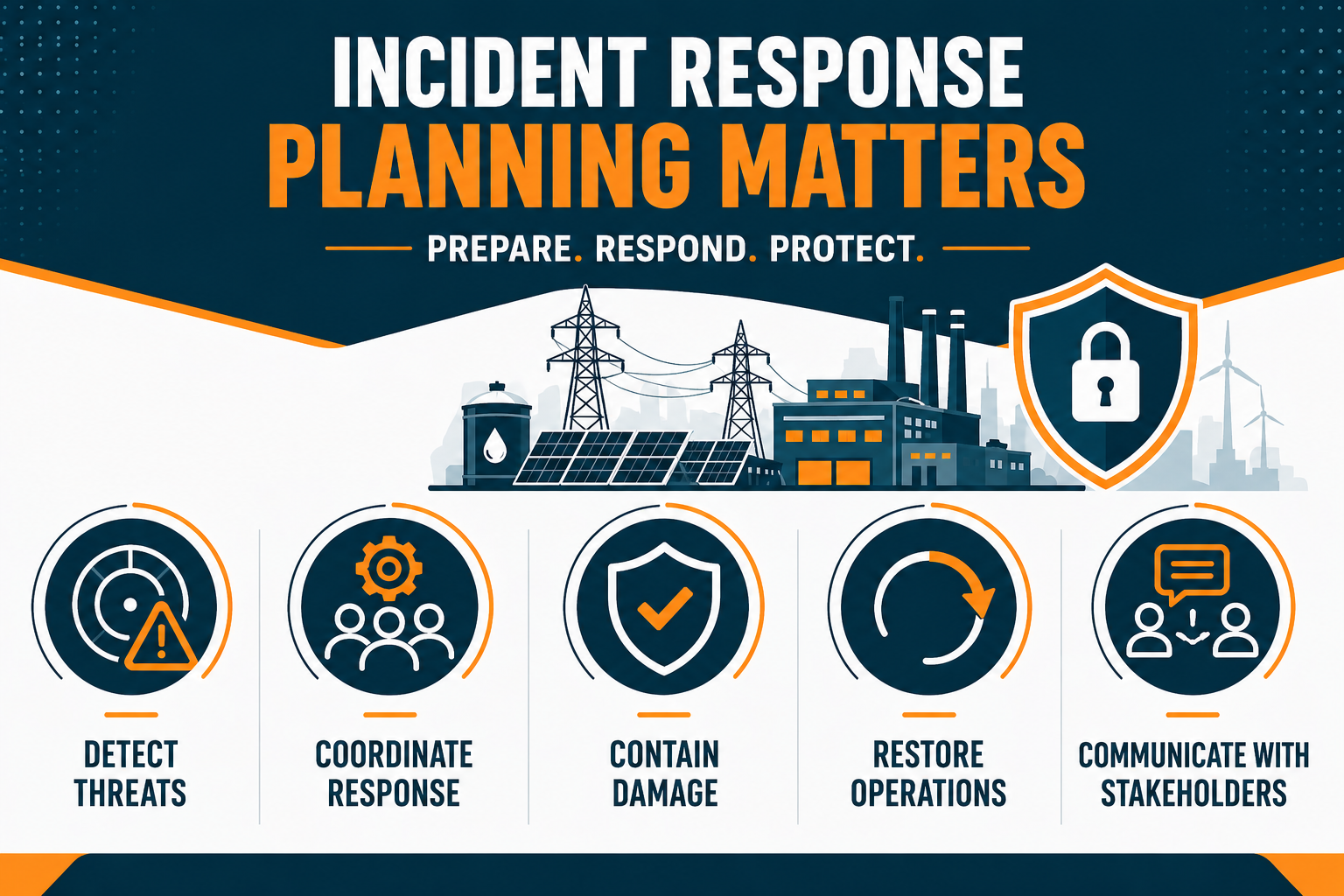
Without a response plan, security teams react inconsistently. Alert triage slows down. Escalation paths stay unclear. Communication with leadership, customers, and partners, and industry and government partners becomes fragmented. Recovery workflows depend on improvisation instead of preparation. That creates operational risk, extends downtime, and increases the potential impact of a breach on public safety and business continuity.
Incident response planning turns cybersecurity into a structured operational capability. It connects threat detection, investigation, containment, and recovery into workflows that security teams can execute under pressure. It defines who makes decisions, how incidents escalate, when to involve third-party vendors, and how to communicate with internal and external stakeholders. It establishes testing schedules, training requirements, and continuous improvement processes that keep response readiness aligned with the utility sector's evolving threat landscape.
Energy and utility organizations that invest in incident response planning reduce response time, limit disruption, and protect the reliability of essential services. They build resilience by preparing for cyber incidents before those incidents disrupt operations, compromise control systems, or threaten public trust.
Read Next:
Rethinking Cybersecurity: Turning Risk Into Strategy in the Energy Sector
How to Secure Cloud-Native Infrastructure in the Energy Sector
An incident response plan for energy utilities defines the structure, roles, workflows, and coordination mechanisms that guide response actions from detection through recovery. It should cover incident severity levels, team responsibilities, detection and triage processes, containment and recovery workflows, communication protocols, OT considerations, reporting requirements, third-party coordination, testing schedules, and continuous improvement practices.
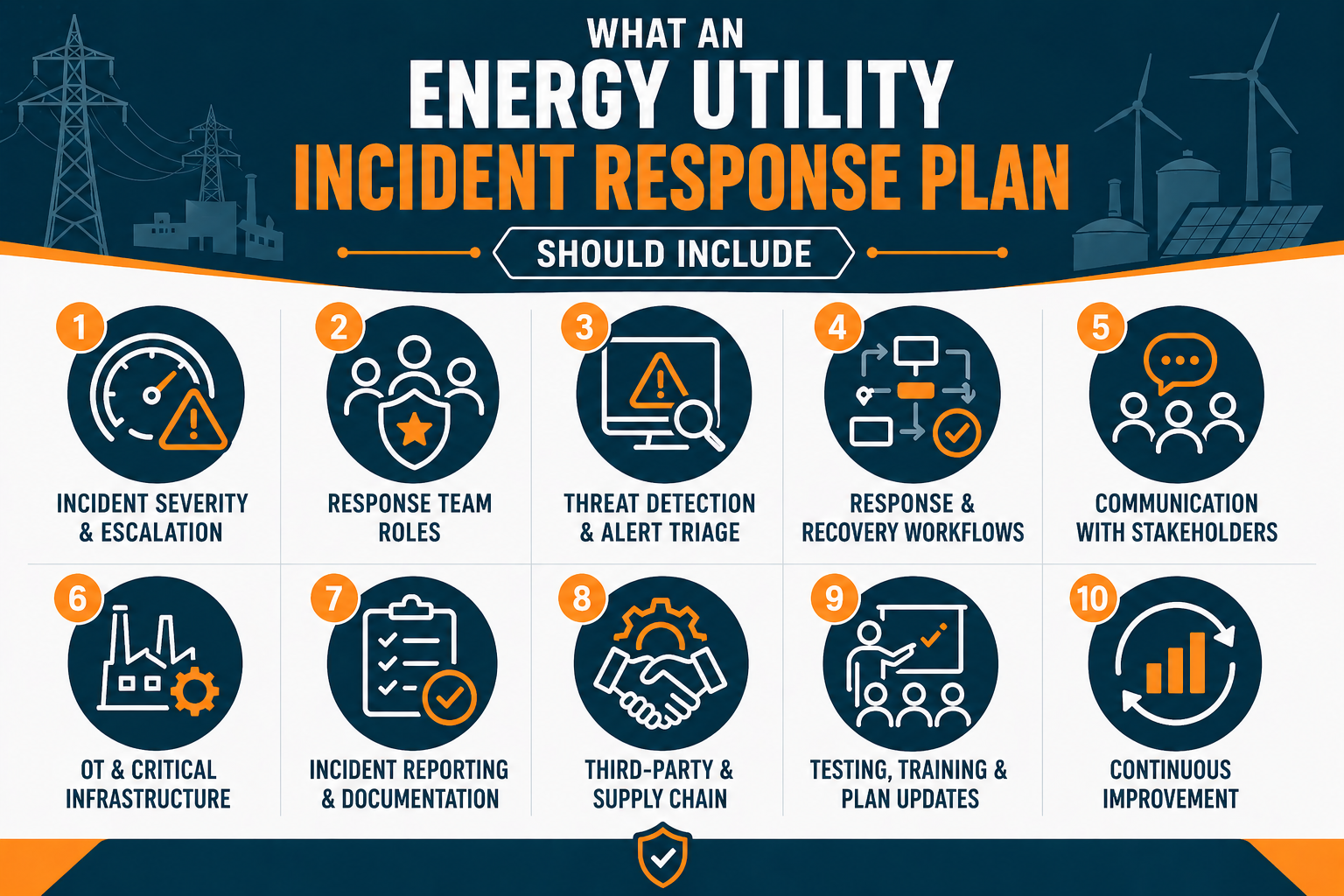
Incident severity levels define how your utility classifies cyber incidents based on operational impact, system criticality, and threat scope. Severity levels determine escalation paths, response timelines, and leadership involvement. A low-severity incident might involve a single compromised endpoint with no operational impact. A high-severity incident could involve ransomware spreading across cloud infrastructure, unauthorized access to control systems, or a breach affecting transmission and distribution operations.
Escalation paths define who gets notified at each severity level, when leadership gets involved, and how incidents move from detection to containment to recovery. Clear escalation paths prevent delays, reduce confusion, and ensure that critical incidents receive immediate attention from the incident response team and executive stakeholders.
Read Next: Rethinking Cybersecurity: Turning Risk Into Strategy in the Energy Sector
Response readiness depends on knowing who does what when a cyber incident occurs. Defining team roles before an incident happens eliminates confusion, speeds up coordination, and ensures that every response function has clear ownership.
Incident Commander: Leads response coordination, makes containment and recovery decisions, and manages communication with leadership and external stakeholders during active incidents.
Security Analysts: Monitor security tools, triage alerts, investigate suspicious activity, and identify indicators of compromise across cloud, endpoint, network, and identity layers.
IT and OT Leads: Coordinate containment and recovery actions across IT systems and operational technology, ensuring that response workflows don't disrupt essential services or control system operations.
Communications Lead: Manages internal and external communication, including incident reporting, stakeholder updates, regulatory notifications, and coordination with industry and government partners.
Legal and Compliance: Ensures incident response actions align with regulatory requirements, manages breach notification workflows, and coordinates with legal counsel when incidents involve data exposure or third-party liability.
Threat detection starts with visibility across the systems that matter most to utility operations. Energy utilities need monitoring coverage across cloud infrastructure, endpoints, networks, identities, and operational technology. Detection tools generate alerts when suspicious activity occurs, but not every alert represents a real threat. Alert triage separates real incidents from false positives, prioritizes investigation based on severity and impact, and routes high-priority alerts to security teams for rapid response.
Effective triage depends on context. Security teams need to understand what systems are involved, what data is at risk, whether the activity matches known attack patterns, and whether the alert connects to other suspicious events. Intelligent alert triage reduces noise, speeds up investigation, and ensures that security teams focus on the incidents that pose the greatest risk to utility cybersecurity and operational resilience.
Read Next: How to Secure Cloud-Native Infrastructure in the Energy Sector
Response and recovery workflows define the actions your utility takes to contain threats, eliminate attacker access, restore affected systems, and return to normal operations. These workflows should be specific, repeatable, and tested regularly.
Containment Actions: Isolate compromised systems, disable unauthorized accounts, block malicious traffic, and prevent lateral movement across cloud, endpoint, and network environments.
Eradication Steps: Remove malware, close vulnerabilities, revoke compromised credentials, and eliminate attacker persistence mechanisms before restoring systems to production.
Recovery Procedures: Restore systems from clean backups, validate system integrity, apply security patches, and confirm that affected systems are secure before bringing them back online.
Validation and Monitoring: Monitor restored systems for signs of reinfection, verify that security controls are functioning correctly, and confirm that operations have returned to normal without residual risk.
Incident response requires clear communication with multiple audiences. Internal stakeholders include leadership, IT and OT teams, legal and compliance, and operational staff who need to understand how the incident affects their work. External stakeholders include customers and partners, regulatory agencies, industry and government partners, and third-party vendors involved in response or recovery.
Communication workflows should define who communicates what information, when updates occur, and how sensitive details are protected. Effective communication reduces confusion, maintains public trust, supports regulatory compliance, and ensures that everyone involved in response and recovery stays aligned on priorities and progress.
Energy utilities operate operational technology that controls physical processes, monitors equipment health, and manages transmission and distribution systems. OT environments have unique cybersecurity challenges. Control systems often run legacy software, lack modern security features, and require high availability to maintain essential services. Incident response workflows for OT must balance containment with operational continuity, ensuring that response actions don't disrupt power generation, water treatment, or energy supply.
OT incident response requires coordination between IT security teams and operational staff who understand control system behavior, safety protocols, and the potential impact of containment actions on public safety. Response plans should define when to escalate OT alerts, how to validate control system incidents, and how to contain threats without causing unplanned outages or equipment damage.
Read Next:
IT Due Diligence: Zero Trust Architecture for Energy Companies
Cybersecurity Challenges in Distributed Energy Systems: Securing the Smart Grid
Incident reporting and documentation create a record of what happened, how your utility responded, and what outcomes resulted. Documentation supports regulatory compliance, internal accountability, and continuous improvement. It also provides evidence for legal proceedings, insurance claims, and post-incident reviews.
Incident Timeline: Record when the incident was detected, how it escalated, what containment actions were taken, and when systems were restored to normal operations.
System and Data Impact: Document which systems were affected, what data was accessed or compromised, and how the incident impacted utility operations and essential services.
Response Actions Taken: Capture containment steps, recovery procedures, communication activities, and coordination with third-party vendors or external partners.
Lessons Learned: Identify what worked, what didn't, and what changes should be made to improve future response readiness and reduce similar risks.
Energy utilities depend on third-party vendors for software, hardware, cloud services, and operational support. When a cyber incident involves a third-party breach or supply chain compromise, response workflows must extend beyond your utility's direct control. Third-party coordination defines how your utility communicates with vendors, assesses supply chain exposure, restricts vendor access during incidents, and validates that third-party systems are secure before restoring connectivity.
Supply chain incidents require rapid impact assessment. Security teams need to understand which vendors have access to critical systems, what data they can reach, and whether compromised vendor credentials could be used to move laterally into utility infrastructure. Coordination workflows should define escalation paths, communication protocols, and access restriction procedures that protect your utility while maintaining necessary vendor relationships.
Incident response plans only work if security teams know how to execute them under pressure. Testing and training ensure that response workflows are practical, team roles are clear, and coordination mechanisms function correctly when real incidents occur.
Read Next: Evaluating Cybersecurity Vendors for Energy Companies & Distributed Energy Systems
Every cyber incident creates an opportunity to improve response readiness. Continuous improvement processes capture lessons learned, identify gaps in detection or containment, and update response workflows to address weaknesses exposed during real incidents. Post-incident reviews should involve security teams, IT and OT leads, leadership, and any third-party vendors involved in response or recovery.
Continuous improvement turns incident response into a learning system. It ensures that your utility's response plan evolves with the threat landscape, incorporates new security tools and techniques, and reflects operational changes that affect critical infrastructure protection. Utilities that prioritize continuous improvement reduce response time, limit disruption, and build long-term resilience against cybersecurity threats.
Energy utilities face a range of cyber incidents that can disrupt operations, compromise control systems, and threaten public safety. Understanding common incident types helps security teams prepare response workflows, prioritize detection efforts, and allocate resources to the threats that pose the greatest risk to utility cybersecurity and operational resilience.
| Cyber Incident | Potential Utility Impact | Response Priority |
|---|---|---|
| Ransomware attack | Disrupted systems, delayed operations, data loss, business interruption | Containment, recovery, communication, and backup validation |
| Credential compromise | Unauthorized access to cloud, endpoint, identity, or operational systems | Account isolation, access review, and investigation |
| Third-party breach | Supply chain exposure, vendor access abuse, or shared system compromise | Vendor coordination, access restriction, and impact assessment |
| OT or control system alert | Potential risk to operational technology, reliability, or public safety | Escalation, validation, and controlled containment |
| Phishing or social engineering | Compromised users, malware entry, or unauthorized access | User containment, investigation, and security awareness follow-up |
| Cloud or endpoint compromise | Threat actor access to workloads, devices, or sensitive data | Detection, triage, containment, and remediation |
| Data exposure | Compliance risk, public trust damage, and stakeholder concern | Scope review, notification workflow, and access control review |
Read Next: Cybersecurity Challenges in Distributed Energy Systems: Securing the Smart Grid
Incident response readiness depends on continuous monitoring, real-time threat detection, and rapid response capabilities that most energy utilities can't maintain with internal resources alone. Managed security services provide 24×7 monitoring, expert analysts, security tooling, and automated response workflows that improve detection speed, containment effectiveness, and long-term security posture.
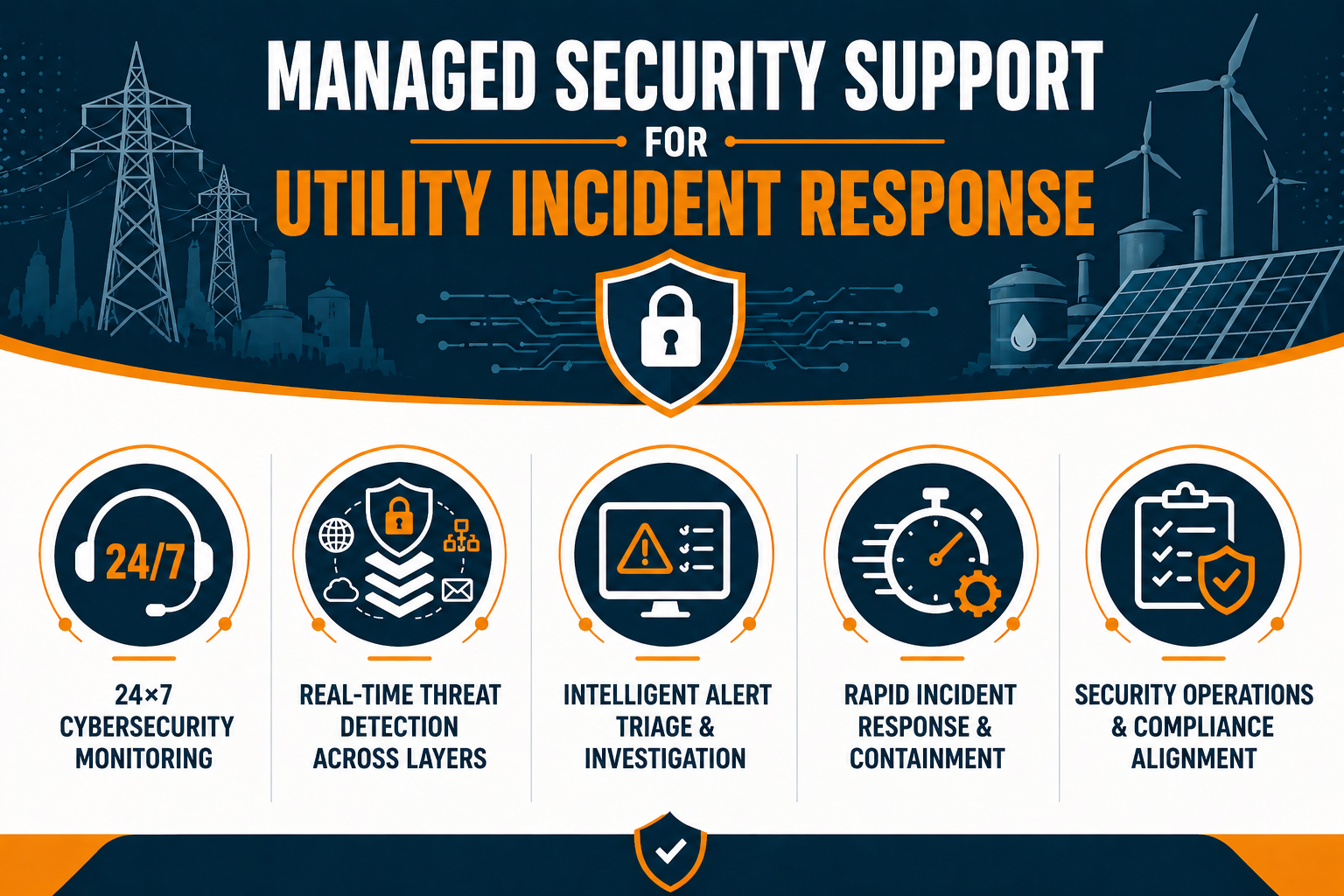
Cyber threats don't follow business hours. Attackers target energy utilities at night, on weekends, and during holidays when security teams are less likely to be watching. 24×7 cybersecurity monitoring ensures that threats are detected, triaged, and escalated immediately, regardless of when they occur. Continuous monitoring provides visibility across cloud infrastructure, endpoints, networks, and identities, generating alerts when suspicious activity appears and routing high-priority incidents to security teams for rapid response.
Around-the-clock monitoring reduces attacker dwell time, limits lateral movement, and prevents incidents from escalating into operational disruption. It ensures that security teams can detect credential compromise, ransomware activity, unauthorized access, and control system alerts before those threats compromise critical infrastructure or disrupt essential services.
Read Next: Evaluating Cybersecurity Vendors for Energy Companies & Distributed Energy Systems
Effective threat detection requires visibility across the systems that matter most to utility operations. Managed security services provide real-time monitoring and advanced threat detection across multiple security layers, ensuring that threats are identified quickly, regardless of where they appear.
Cloud Infrastructure: Monitor cloud workloads, configurations, and access patterns to detect unauthorized changes, misconfigurations, and suspicious activity in hybrid and multi-cloud environments.
Endpoints: Track endpoint behavior, identify malware, detect credential abuse, and respond to compromised devices before threats spread across utility networks.
Networks: Analyze network traffic, identify lateral movement, detect command-and-control communication, and block malicious connections before attackers reach critical systems.
Identities: Monitor authentication events, detect credential compromise, identify privilege escalation, and enforce role-based access controls that limit unauthorized access to sensitive systems.
Security tools generate thousands of alerts every day. Most of those alerts are false positives, misconfigurations, or low-priority events that don't require immediate action. Intelligent alert triage uses automation, threat intelligence, and behavioral analysis to filter noise, prioritize real threats, and route high-severity incidents to expert analysts for investigation.
Human-led investigation adds context that automated tools can't provide. Security professionals analyze alert patterns, correlate events across systems, assess operational impact, and determine whether suspicious activity represents a real cyber incident or a benign anomaly. That combination of automation and expertise reduces response time, improves accuracy, and ensures that security teams focus on the threats that pose the greatest risk to utility cybersecurity and operational resilience.
When a cyber incident occurs, response speed determines how much damage occurs. Rapid incident response and containment workflows limit attacker access, prevent lateral movement, and stop threats before they disrupt operations or compromise critical infrastructure.
Automated Containment: Use automated playbooks to isolate compromised systems, disable unauthorized accounts, and block malicious traffic immediately after detection without waiting for manual intervention.
Expert-Led Response: Deploy security professionals who understand utility cybersecurity, OT environments, and critical infrastructure protection to coordinate containment actions that balance security with operational continuity.
Coordinated Recovery: Work with IT and OT teams to restore affected systems, validate security controls, apply security patches, and confirm that operations have returned to normal without residual risk.
Post-Incident Analysis: Conduct post-incident reviews to identify root causes, document lessons learned, and update response workflows to improve future readiness and reduce similar risks.
Energy utilities operate in a regulated environment where cybersecurity incidents trigger reporting requirements, regulatory scrutiny, and compliance obligations. Managed security services help utilities align security operations with regulatory frameworks, maintain incident reporting workflows, and demonstrate that security controls meet industry standards for critical infrastructure protection.
Security operations support includes regular security audits, vulnerability assessments, risk management processes, and compliance documentation that help utilities meet requirements from the Department of Energy, industry regulators, and government partners. That alignment reduces compliance risk, supports regulatory reporting, and ensures that incident response workflows reflect the unique cybersecurity challenges facing the energy and utilities sector.
Incident response planning for energy utilities defines how your organization detects, investigates, contains, and recovers from cyber incidents before they disrupt essential services, compromise control systems, or threaten public safety. Response readiness depends on clear team roles, structured workflows, continuous monitoring, and coordination across IT, operational technology, and leadership. Utilities that invest in incident response planning reduce response time, limit operational disruption, and build long-term resilience against cybersecurity threats.
Response Readiness: Energy utilities need incident response plans before cyber threats disrupt operations.
Operational Resilience: Response and recovery workflows help protect essential services, uptime, and public trust.
Security Visibility: Continuous monitoring helps security teams detect, triage, and respond to real risk.
Response planning works best when monitoring, recovery, and leadership decisions are connected.
Serverless Solutions provides managed, secure, and AI-powered IT services designed to improve utility cybersecurity and operational resilience. Our Managed Security Services include 24×7 monitoring, rapid response, and managed detection and response across hybrid, cloud, and on-prem environments.
Talk to an expert to evaluate your utility incident response readiness and strengthen monitoring, detection, and recovery across critical systems. Most utilities don’t realize where their response plan breaks until it’s too late.
Incident response planning for energy utilities defines the workflows, team roles, escalation paths, and coordination mechanisms that guide detection, containment, recovery, and communication when cyber incidents occur. It prepares utilities to respond quickly and effectively to ransomware attacks, credential compromise, third-party breaches, and OT system alerts before those incidents disrupt operations or compromise critical infrastructure.
Energy utilities operate critical infrastructure that supports essential services, public power, and national security. Cyber incidents can disrupt operations, compromise control systems, and threaten public safety. Incident response plans reduce response time, limit operational disruption, and ensure that security teams can contain threats before they escalate into business interruption or damage public trust.
An incident response plan should include incident severity levels, escalation paths, clear team roles, threat detection and alert triage processes, response and recovery workflows, communication protocols, OT and control system considerations, incident reporting requirements, third-party coordination procedures, testing schedules, and continuous improvement practices that keep response readiness aligned with emerging threats.
Energy utilities commonly face ransomware attacks, credential compromise, third-party breaches, OT or control system alerts, phishing and social engineering, cloud or endpoint compromise, and data exposure incidents. Each incident type requires specific response workflows, containment actions, and recovery procedures to protect utility operations and critical infrastructure.
24×7 monitoring ensures that cyber threats are detected, triaged, and escalated immediately, regardless of when they occur. Continuous monitoring reduces attacker dwell time, limits lateral movement, and prevents incidents from escalating into operational disruption. It provides visibility across cloud infrastructure, endpoints, networks, and identities, generating alerts when suspicious activity appears and routing high-priority incidents to security teams for rapid response.
Managed security services provide 24×7 monitoring, real-time threat detection, intelligent alert triage, rapid incident response, and security operations support across hybrid, cloud, and on-prem environments. They combine security tooling, expert analysts, and automated response workflows to improve detection speed, containment effectiveness, and long-term security posture for energy and utility organizations.

15 min read
Energy companies now face a security problem that didn't exist a decade ago. The systems that run business operations and the systems that control...

11 min read
Buying more tools doesn't create a strategy. A cybersecurity strategy for critical infrastructure starts with governance, not technology. It defines...
1 min read
The latest generation Large Language Model (LLM), GPT-4, is now available in the Azure OpenAI Service. The GPT-4 model was trained against a much...